
Is it condensation, seepage or a plumbing leak?
Basement waterproofing is the set of drainage and sealing measures that keep groundwater and surface water out of a basement. The right one depends on where the moisture comes from, which is why we figure that out before anything else.
| What you see | Likely cause | How to tell |
|---|---|---|
| Damp patches on cold walls in summer, wet cold pipes | Condensation from humid air | Worse in warm, muggy weather and clears with a dehumidifier |
| Water at the wall-floor joint after rain | Groundwater or surface runoff | Follows rainfall by hours or a day, may smell earthy |
| Wet spot that appears with no rain | Plumbing leak, supply or drain | The meter moves, or the spot tracks with water use |
| White powder on masonry | Mineral salts left behind by moving moisture | Brushes off, returns where moisture keeps coming through |
A simple test: tape a square of plastic or foil to the wall for a day or two. Moisture on the room side points to condensation, and moisture under the plastic points to seepage.
Trace the moisture before you pay for anything
Waterproofing work can cost a lot of money, so the first job is figuring out what is actually wet. A dehumidifier, a downspout extension or a pipe repair can settle many cases for far less than interior drainage.
We check for plumbing leaks first with a meter test and a look at supply lines, drains and the water heater. We also check the sump, the floor drain and any laundry connections. If the source is plumbing, leak detection finds it. If the source is groundwater, we move on to the outside.
Outside the house: the cheapest fixes come first
Sending roof water farther from the foundation costs the least and is checked first.
- Downspouts that discharge at least several feet from the wall, with extensions or splash blocks
- Gutters that are clean and not overflowing at the corners
- Soil that slopes away from the foundation, not toward it
- Window wells that are clear, with a drain at the bottom if possible
- Planting beds and mulch kept below the siding and not building up against it
- Sump pump discharge ending well away from the house
Not sure where the water is coming from?
Describe where it shows up and when. We can tell you whether it sounds like plumbing, groundwater or humidity.
When interior drainage makes sense
If outside fixes are in place and water still enters, interior drainage manages it where it arrives.
- 1
Open a channel
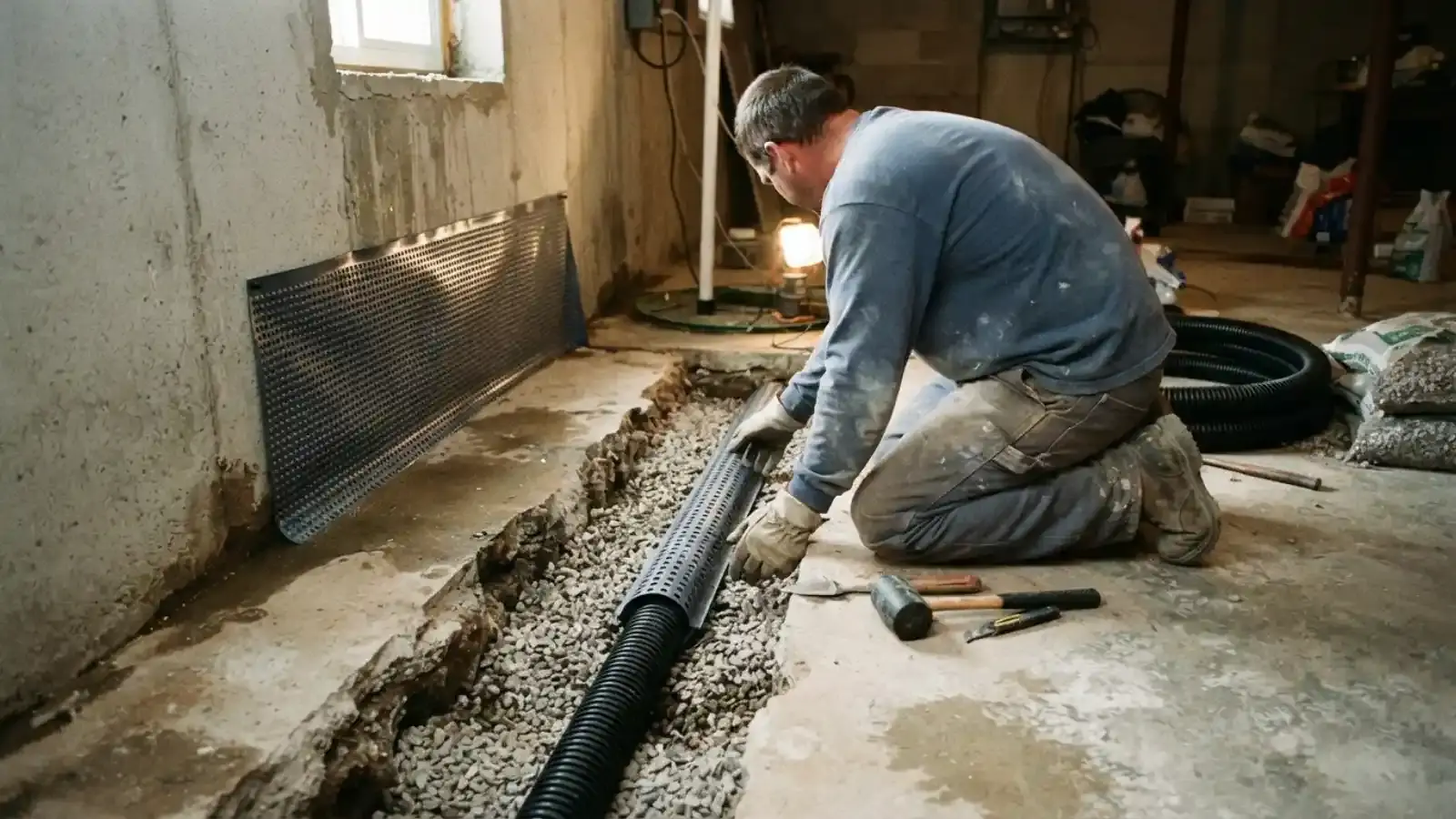
A trench is cut along the inside edge of the slab, along the wall where water enters.
- 2
Lay drain tile
A perforated pipe set in gravel collects water at the footing.
- 3
Route to a sump
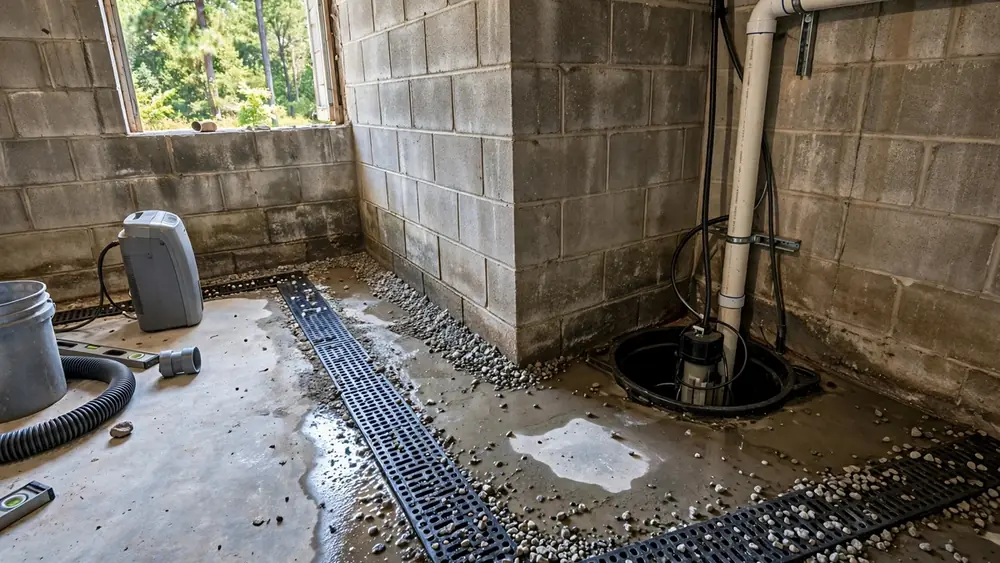
The pipe slopes to a sump pit, and a pump sends the water outdoors. See sump pump installation and repair.
- 4
Close and finish
New concrete patches the trench. The wall surface is left for you or a contractor to finish.
- 5
Test with water
We run water through the system to confirm that it flows to the pit and the pump clears it.
Wall cracks, bowing walls and where plumbing work stops
Hairline cracks in poured concrete are common and often cosmetic, but a crack that is wider than a pencil line, stair-steps through block, or leaks after every rain should be looked at. A wall that bows inward, or a floor that heaves, points to soil pressure and structure, not drainage.
That is outside plumbing. A structural engineer should evaluate it, and the drainage work we do may follow the engineer's plan. We do the plumbing and drainage side: drain tile, sump pits, pumps, discharge lines and floor drains. We do not promise a dry basement, and we do not offer a warranty on seepage. We tell you what we expect the work to do.
Surface fixes or interior drain tile
Surface fixes first
- Downspout extensions, grading and gutter cleaning cost little and take little time
- They reduce the water against the foundation in the first place
- They cannot handle a high water table or a wall that stays wet
- They are worth trying before any interior excavation
Interior drain tile
- Collects water that gets to the footing and gets it out
- Works in all seasons and does not depend on yard slope
- Requires cutting the slab and running a sump pump
- Does not stop water from entering the wall, it only controls it
What affects the work
Each basement has its own conditions. We look at these before recommending drainage.
Soil type
Soil that drains slowly holds water against the wall, so seepage is more likely.
Slope of the yard
Yards that slope toward the house push runoff to the foundation.
Foundation type
Poured concrete, block and old stone behave differently when wet.
Floor finish
Carpet, tile or a finished wall will need removal in the drain path.
Want it looked at?
Call and describe the moisture. We will help you decide whether a visit makes sense and what to check beforehand.
Water events on record near Etna, and what each one points to
NOAA and FEMA records give a local picture of how water moves here. None of it replaces looking at your own wall, but it narrows where to start.
Roads under water
High water was logged on State Route 310 (6 May 2003), at Sycamore Creek near Etna (13 July 2017) and on Watkins Road SW near Creek Road SW (17 Feb 2022). Those are surface-water years, so check downspouts, grading and window wells before assuming groundwater is rising through the floor.
Recent floods
A flood was recorded on 28 March 2020 and water covered York Road on 25 June 2025. If your wall wept after either, note which door or window well sat lowest, because that is where drainage work usually begins.
The soil under you
Soil at the address of our Etna office is mapped as Cardington silt loam, a moderately well drained glacial till. Moderately well drained means water can linger after a long rain, which fits a wall that weeps a day later. Lots vary, so treat it as a clue and not a finding.
The flood map
FEMA revised the Etna South Tributary flood map (effective 18 July 2023) and the county posts a floodplain map viewer. Looking up your lot shows whether surface flooding is a known risk, which decides whether grading or interior drain tile comes first.
Frequently asked questions
Tape a plastic or foil square to the wall for 24 to 48 hours. Moisture on the outside of the foil means humid room air is condensing. Moisture underneath means water is coming through the wall. If a spot stays wet with no rain, check the water meter.
No. We do not offer guarantees or warranties on seepage, and no honest contractor can promise a basement will never see water. We tell you what we expect a repair to do, what it cannot do, and which parts of the problem sit outside plumbing and drainage.
No. Structural and foundation problems need an engineer. We handle drainage and plumbing: drain tile, sump pits and pumps, discharge lines and floor drains. If we see signs of structural movement, such as a wall bowing inward, we say so and suggest an evaluation first.
It helps when water collects at the footing and needs somewhere to go. It does nothing for condensation, a plumbing leak, or water running in through a window well. That is why we trace the source first, then decide whether a pit and pump belong in the plan.
Start outside, with downspouts, gutters and grading. They are the least disruptive and often improve things noticeably. If water still enters after those fixes, interior drainage controls it at the footing, and the two approaches work well together.
During or just after a heavy rain or a spring thaw, when you can see where water appears. Take photos, note the time, and mark the wall with painter's tape. That tells us whether it follows rainfall or something else, and it saves a lot of guessing.