Line packed solid and backing up right now
Hydro jetting is a drain cleaning method that sends high-pressure water through a hose and nozzle to scour grease, scale and roots off the inside of a pipe. If your line is overflowing, a person answers our line 24/7, and jetting may be the right tool once we see what is blocking it.
Jetting needs a clear path and a known pipe condition, so the first job is getting a picture of the situation. Use the minutes before we arrive to limit the water that reaches the blockage.
Shut off the washer and dishwasher
These push the most water, the fastest.
Do not flush
A toilet empties several gallons into a line that is already full.
Find your cleanout
A capped pipe in the basement, crawlspace or yard is where a jetter hose goes in. Clear the space around it.
Say what changed recently
Tree work, a long vacant stretch or a past root clog all steer the plan.
How a hydro jetter actually works
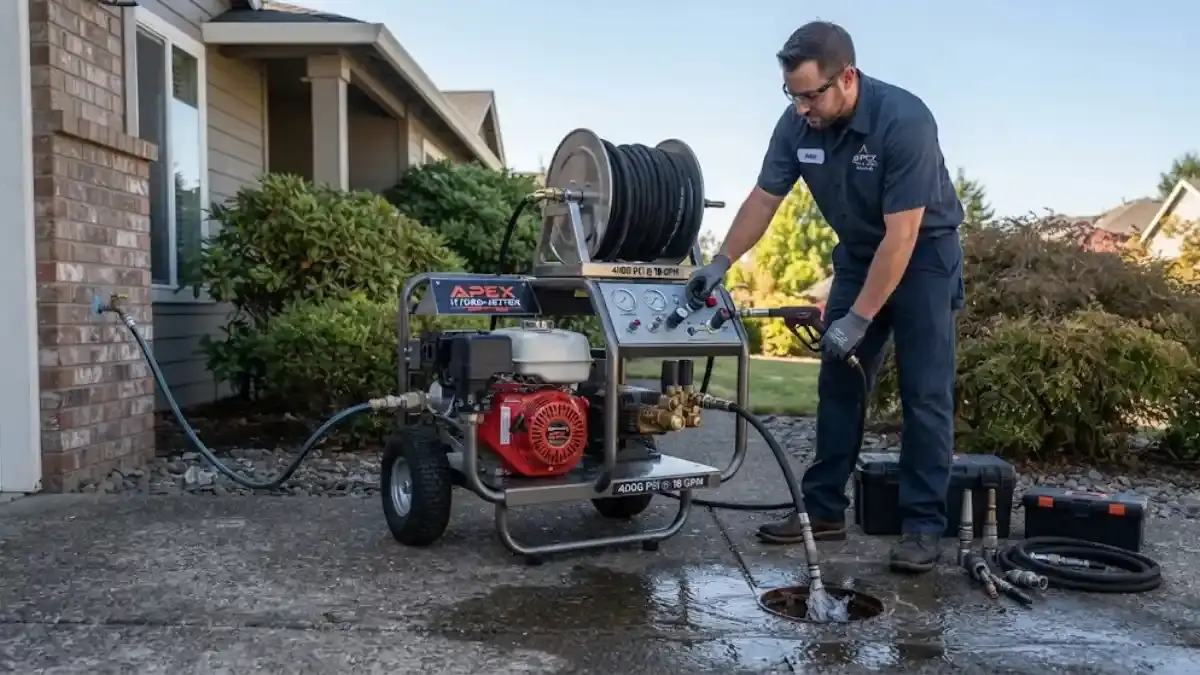
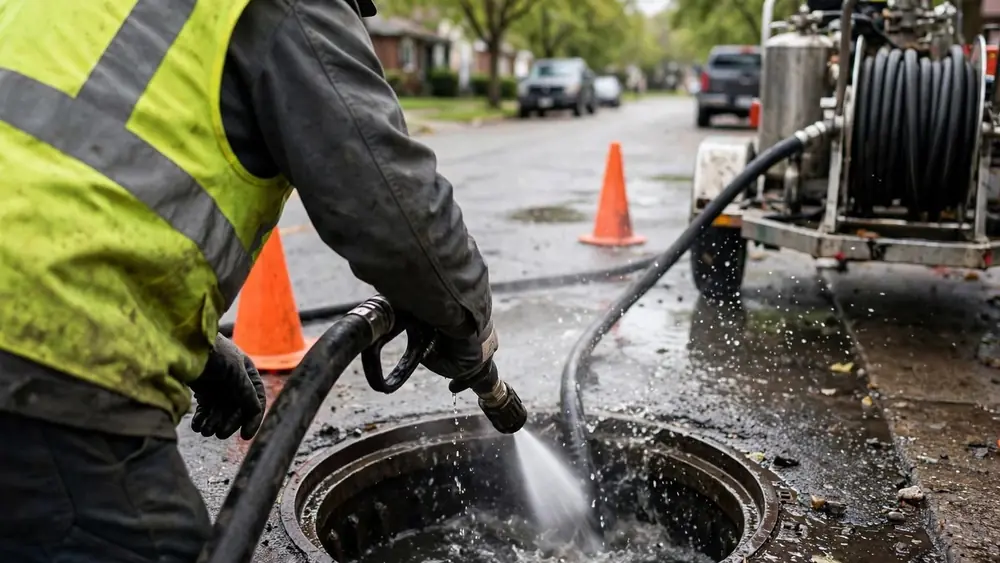
A trailer or truck-mounted unit pumps water from a tank through a flexible hose at pressures that run into the thousands of psi on larger machines, far beyond a garden hose. The hose ends in a nozzle with rear-facing jets. Those jets pull the hose forward along the pipe while they scour the wall and push debris back toward the opening.
That is the real difference from a cable. A cable spins a blade through the middle of the pipe and leaves the coating on the walls. Water moving at speed along every surface, around the full circumference, returns the pipe close to its original bore.
Where jetting beats cabling
Jetting earns its place on some blockages and is a waste of effort on others.
Grease and soap buildup
Kitchen and restaurant-style lines coat with fat that cables bore through. Water at pressure strips it from the pipe wall.
Scale in older iron
Cast iron pipes tuberculate over the decades. Jetting removes loose scale and widens the flow path without chewing the pipe.
Fine root hairs
A rotary nozzle clears hair-like roots at a joint. Thick woody roots may need a cutter head first, then a jetting pass.
Recurring clogs
If a main line has been cabled three times in a year, a full wall cleaning plus a camera check is usually the next step.
Not sure which one you need?
Describe the clog history and we will tell you whether cabling, jetting or a camera should come first.
Before and after: how we confirm the result
We do not jet blind and we do not leave without checking the pipe afterward.
- 1
Camera first
A push camera goes through the cleanout so we can see the pipe material, any cracks, sags or offset joints, and what is actually blocking the flow.
- 2
Choose the nozzle
A penetrating nozzle drills through a hard plug, a rotary nozzle scours the wall, and a flat-spray tip is gentler for thin or old pipe.
- 3
Jet in passes
We advance the hose slowly, pull back along the wall, and repeat through problem sections. Pressure is set for the pipe, not the maximum the machine can deliver.
- 4
Camera again
The second pass shows whether the wall is clean. You see the same footage, and we explain what it shows in plain words.
Cabled before and it came back?
Tell us how often the line has clogged and where. That history helps us decide if jetting is the right next move.
When we will not jet a line
Water pressure that cleans a sound pipe can open up a weak one. If the camera shows a collapsed section, a crushed pipe, a large offset or an Orangeburg-type fiber pipe that has lost its shape, we stop and talk about repair instead. Jetting a pipe that is already failing can move the break and bring soil into the line.
In that case, the plumbing job becomes sewer line repair and the jetting waits until the pipe is sound enough to take it. We would rather tell you that in the first hour than clean a pipe that needs replacing.
Cable or jetter: a plain comparison
Cabling
- Quick for a single sink or tub clog
- Cuts through soft plugs and some roots
- Leaves a film of grease on the pipe wall
- Works where the line has bends a hose cannot take
Hydro jetting
- Better for repeat clogs in kitchen and main lines
- Cleans the entire circumference, not just a core
- Needs an access point large enough for the hose
- Needs a camera check first on old or damaged pipe
Jetting and what it does for the whole drain system
A jetted line stays open longer because the pipe wall is clean and the flow path is back to full size. That helps every fixture upstream, and it makes later camera work easier because the footage is not smeared with grease.
We pair jetting with simple habits at the sink and with a camera pass if the line was cabled repeatedly before. See drain cleaning for the everyday clog work, and sewer line cleaning when the blockage is at the main. If a camera finds roots in a joint, sewer inspection explains how we document the line.
Where jetting fits in Etna Township
Most township homes went up between 1990 and 2009 (about 4,000 of 7,100 occupied homes, median year built 1995). Their drain lines are typically plastic, which jetting cleans well, so a pass in a newer house is usually about grease or paper film rather than corroded iron.
The roughly 290 homes that predate 1940 are mostly farmhouses, and an iron or clay line in one of them gets the camera before any pressure goes in. That rule of thumb carries over to jobs in Pataskala, Kirkersville and Reynoldsburg.
Before you book, check with the water district on whether your street is sewered, and find the cleanout so the hose has a clear way in.
Frequently asked questions
A backed-up line does not wait for business hours, so a person picks up our line at any hour. From there we schedule the soonest same-day or overnight visit we can, and we tell you plainly if a camera look has to come before any jetting, since blasting a damaged pipe can make things worse.
On a sound pipe, no. On a cracked, collapsed or heavily corroded one, high pressure can open the weak spot, so we look first with a camera and set the pressure and nozzle to suit the pipe. If the pipe is failing, we recommend repair instead.
A snake cuts a path through the middle of a blockage. A jetter washes the whole pipe wall with water at speed, which clears grease film and scale a cable leaves behind. For a simple sink clog, a cable is often enough.
It clears fine roots well and can break up thicker ones. Heavy woody roots usually need a cutter head first. Roots grow back where a joint leaks, so recurring root clogs may eventually mean a repair.
A cleanout makes it much easier because the hose has a straight path into the main. Without one, we can sometimes jet through a pulled toilet or a roof vent, and we may recommend adding a cleanout while the line is open.
Yes, the house-side pipe, as long as a camera shows it is sound. Tanks are outside our work, and loosened debris moves downstream, so have the tank looked at by a septic service if it is due. Septic permits and inspections sit with the county health department. Not sure if you are sewered? The water district can say.