
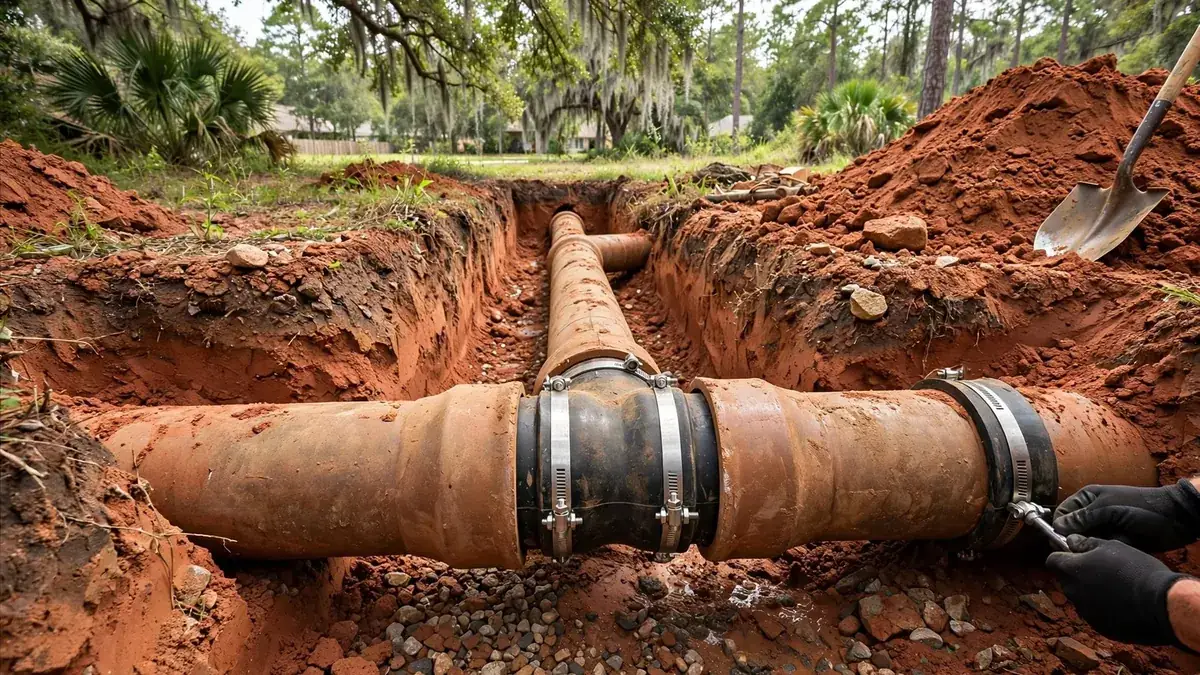
Sewer line failing: what to do while you wait
Sewer line repair in Etna means restoring a failed length of the buried pipe between your house and the public sewer or septic tank. If sewage is coming up in the house or a sinkhole has opened in the yard, a person answers our line 24/7. The steps below keep the damage from spreading.
A broken sewer line can look like a clog, but cabling a collapsed pipe only pushes soil further in. Stop water use and let us find out which problem you have.
Stop using water
Every gallon going down a broken pipe soaks the soil around it.
Mark wet or sunken ground
Take a photo of the yard and note where it is soft.
Keep kids and pets away
Sewage-soaked soil and an open cleanout are both unsafe.
Do not dig
Pipes, gas and electric can share the same ground.
Repair methods and their trade-offs
The right method depends on what the camera shows. Here is how the main options compare.
| Method | Best for | Trade-off |
|---|---|---|
| Spot repair (dig and replace a section) | One cracked or offset joint, with the rest of the pipe sound | Needs a trench at the break, so yard or driveway disturbance is limited to that spot. |
| Pipe lining (cured-in-place) | Long runs of cracked or root-prone pipe that has not collapsed | Less digging, but the pipe must be cleaned first and a collapsed pipe cannot be lined. |
| Pipe bursting | Pipe too far gone to line, but a path clear enough to pull new pipe through | Entry and exit pits are needed, and nearby utilities limit where it is possible. |
| Full open-trench replacement | Collapsed, badly bellied or mixed-material lines | Most disruption, but it lets us reset the slope and replace every bad section. |
No method suits every line. We explain which ones apply once we have seen the footage.
Camera first, repair second
Every sewer repair starts with a camera, because the plan depends on where the damage is, how long it runs and what the pipe is made of. We feed the camera from the cleanout, record the run, and mark the location of any defect with a locator at the surface.
That tells us whether we are looking at a single bad joint, a stretch of root-invaded clay, or a line that has lost its slope for twenty feet. You see the same footage we do. For stand-alone inspections, including house purchases, see sewer inspection.
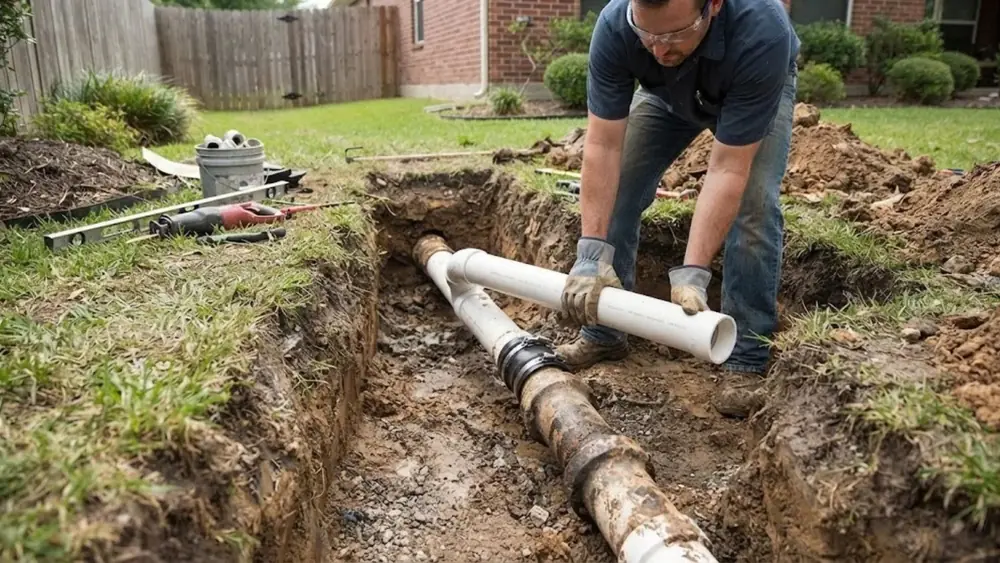
Signs the sewer line itself is damaged
A clog is a blockage. A damaged line has symptoms that return after cleaning.
Repeated backups after cleaning
The same pipe keeps catching waste because of roots, a sag or a broken joint.
Sunken or soggy patch in the yard
Soil is washing into or out of the pipe along the line.
Sewer smell outdoors or in the basement
A crack, an open joint or a dry trap lets gas escape.
Slow drains throughout the house
Several fixtures slow together points to the main, and a cleaning that fades quickly points to the pipe itself.
Lush green strip in the lawn
Leaking sewage fertilizes the grass above it.
What the pipe is made of matters
The age of the house is a rough guide to the pipe material, and each material fails in its own way.
Cast iron
Common in older homes. It corrodes from the inside and scales, and joints can crack or separate.
Clay tile
Older still. Short sections with many joints invite roots, and tile cracks under load or soil shift.
Orangeburg (bituminized fiber)
Used in some mid-century houses. It softens, flattens and delaminates, so it is rarely a candidate for lining.
PVC and ABS
Newer plastic lines resist roots and corrosion, but can sag if the trench was poorly bedded or crack from impact.
Not sure what you have?
A camera run shows the pipe material and condition, and tells us which repair methods are on the table.
Need a sewer line looked at?
Tell us the symptoms and when they started. We will set up a camera visit and explain the options with the footage in front of you.
Where a repair stops on a septic property
The pipe from the house to the tank is plumbing we can repair. The tank, the distribution box and the drain field are septic work, and we do not pump or repair those.
If the camera shows the line is sound and the problem lies at the tank, we say so and point you to a septic service rather than dig up a healthy pipe.
How a repair job runs
- 1
Camera and locate
Find the defect, measure how far from the cleanout, and note the depth.
- 2
Review the options
We lay out which methods fit the damage and what each involves for your yard.
- 3
Prepare the site
Utility marking comes first, and some work may need a permit, which we flag as soon as we see the need.
- 4
Complete the repair
Dig, line or burst, depending on the plan. Work follows the Ohio Plumbing Code.
- 5
Test and re-camera
We run water through the new section and camera it again, so you can see the finished pipe.
Planning a sewer repair in Etna Township
A few local details shape the plan, whether the job is in Etna or a neighbor such as Pataskala, Kirkersville or Reynoldsburg.
Call before any dig
Ohio 811 (OHIO811) needs at least two working days of notice before digging, so utility marks are on the ground before a trench opens. That timing belongs in your repair schedule.
Your lot, not the soil map
The mapped soil at our own address is a moderately well drained glacial till (Cardington silt loam). That is one data point, so the locator and a test hole decide depth and trench plan on your lot.
Who owns which pipe
Storm sewers in the public right-of-way are the township's, while private pipes and ditches are the owner's. If your street is sewered at all, ask the district where its sewer ends and yours begins.
A mixed housing stock
Most township homes date from 1990 to 2009, so a plastic line with a bad joint or a sag is common. A few farmhouses older than 1940 may hold clay or iron. If it only clogs, see sewer line cleaning.
Not sure which situation you have?
A camera run and a surface locator settle the pipe material, the depth and the damage before any digging plan is made.
Frequently asked questions
A collapsed or leaking sewer line does not hold off until morning, so a person answers our line at any hour, weekends included. We book a camera visit for the first same-day or overnight slot we have. Until we arrive, stop using water and keep people and pets off any wet or sunken ground.
A cleaning fixes a blockage. If the drain clogs again within days or weeks, or the yard has soft spots, the pipe itself may be damaged. A camera run shows which one you have.
No. Lining needs a pipe that is still round and open enough to clean thoroughly. A collapsed or heavily offset pipe usually needs a dig or a burst, and we explain which applies after the camera visit.
Not unless the line needs full replacement. Many repairs are limited to a section at the break, and lining or bursting can reduce digging. We lay out the disturbance before work begins.
No. We repair the plumbing between your house and the tank, but pumping, tank repair and drain field work belong to septic specialists.
The Licking County Health Department runs the plumbing program, and a permit covers new work as well as installing, heavily altering or repairing plumbing, with inspections at rough-in and at the end. Replacing a fixture with a similar one in the same spot is the exception. Whether your repair counts is a question for that office, and we tell you if we think it does.