
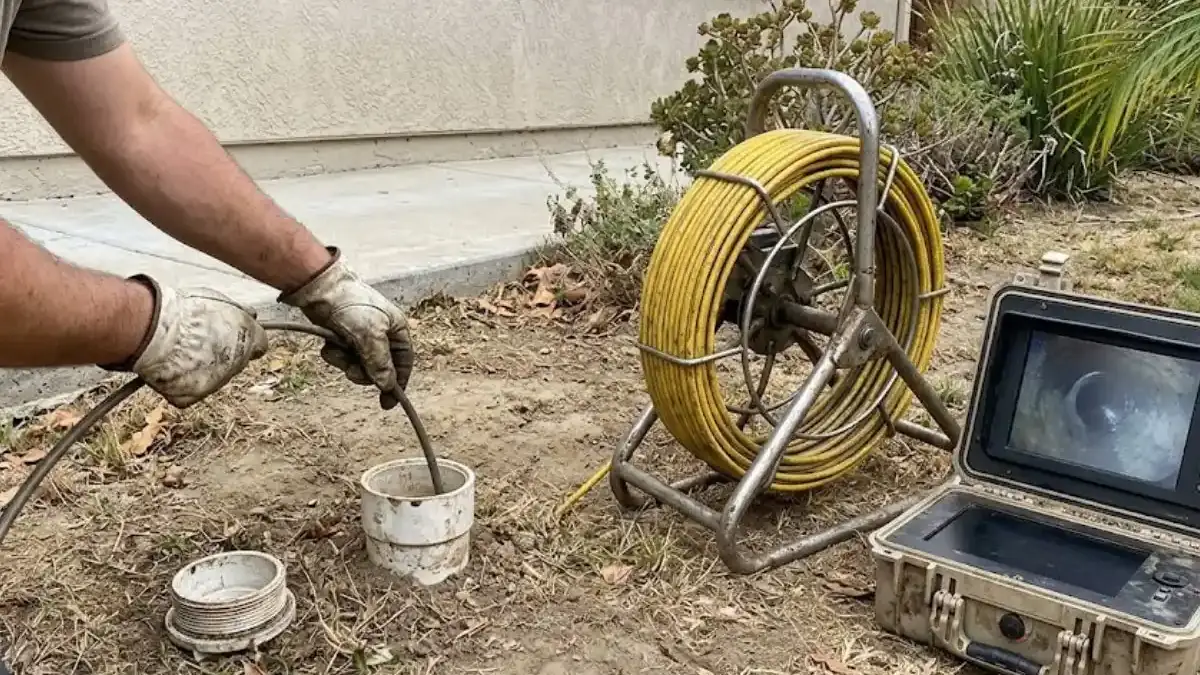
What a sewer camera inspection is
A sewer camera inspection is a visual check of your drain line using a small waterproof camera on a flexible rod. The camera is fed through a cleanout, and you watch the pipe interior on a monitor as it advances. It shows cracks, offset joints, roots, sags, scale and debris that no one can see from the surface.
Without it, a repair or a purchase decision rests on guesswork. With it, you can tell whether a house has a sound line, a line that needs periodic cleaning, or one that will need replacement.
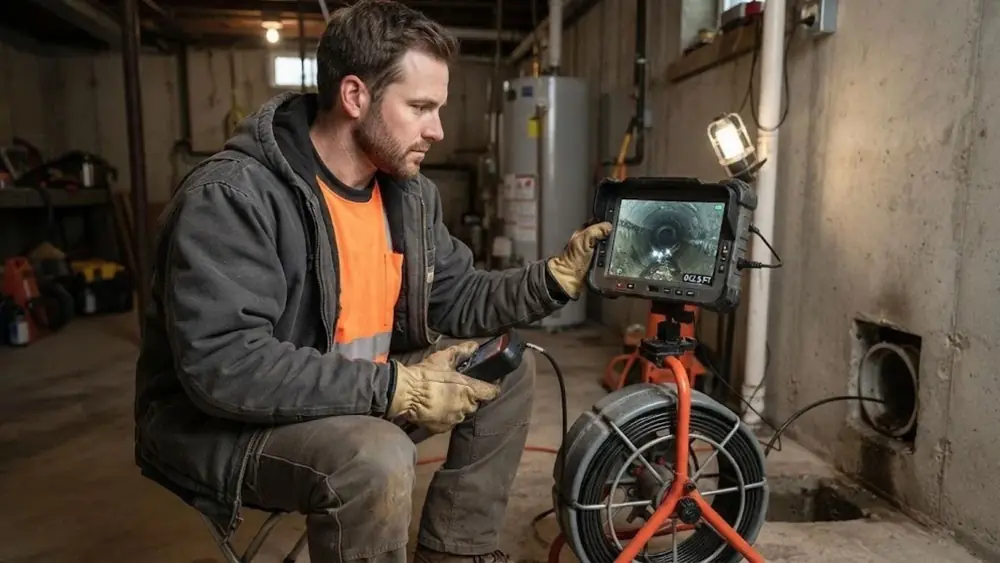
When to order an inspection
Most inspections fall into a few situations.
- Before buying a house, especially an older one or one with mature trees near the line
- After repeated clogs in the main or in several fixtures
- Before landscaping, a new patio or a driveway pour over the line
- After a sewer smell, a damp patch or a sunken spot in the yard
- After a cleaning that brought back roots, scale or heavy debris
- Before a remodel that adds bathrooms or increases the load on the line
What the camera can show
The footage reveals a lot, but each finding means something different for you.
| Finding | What it means | Typical next step |
|---|---|---|
| Hair-like roots at a joint | A small leak is drawing roots in | Cleaning on a schedule, or a repair if it progresses |
| Offset or separated joint | Pipe sections have shifted | Spot repair if isolated |
| Belly (low spot holding water) | Soil settled under the pipe | Monitor or replace the section, depending on depth |
| Cracks along the pipe | Age, load or soil movement | Sewer line repair options, including lining |
| Scale or rough walls | Iron pipe aging | Jetting and periodic checks |
| Clean, smooth pipe | Line in good condition | No action, maybe a recheck in a few years |
What you actually receive
You watch the footage as it is recorded and we explain each finding in plain words as it appears. We tell you where in the line the problem sits, how far from the cleanout, and what we recommend. We do not promise a formal written report, and we do not pad findings.
If a line looks fine, we say that. If it needs work, we describe the options, and you can decide in your own time.
How an inspection goes
- 1
Locate the access
We find the cleanout, or a toilet or vent that can serve as one if there is none.
- 2
Clear light debris if needed
If sludge blocks the view, a short cleaning makes the camera run possible.
- 3
Run the camera
We advance slowly and stop at each joint or anomaly.
- 4
Locate and mark
A transmitter in the camera head lets a locator above ground pinpoint depth and position.
- 5
Review together
We replay the key moments and explain what to do, if anything.
Locating the line above ground
A camera head carries a small transmitter that a handheld locator picks up from the surface. We mark the path and the depth with paint or flags, so you know which way the line runs and how deep it sits. That matters before a fence post, a patio or a tree is planted over it.
Locating also settles a common question on older properties: where the line actually goes. Houses that have had additions, a garage or a moved bathroom often have a route nobody remembers. With the path marked, any later repair can be planned to avoid guesswork and unnecessary digging.
Recurring clogs: why a camera beats another cabling
If a drain has been cleared two or three times in a year, another pass with a cable treats the symptom again. A camera shows whether roots, a sag or a cracked joint keeps catching waste. That turns a repeating service call into a single decision about the pipe itself.
Footage also gives you something concrete to compare if you collect a second opinion. You are looking at your own line, not relying on anyone's description of it.
Buying a house with a line nobody has seen?
Ask for an inspection before closing. It shows what the line needs now and what to plan for later.
What a camera cannot do
A camera sees the inside surface of the pipe, but not what is behind it. It cannot tell you how much soil is washed out around a crack, and it may not pass a severe belly where water hides the view. It cannot go past a full collapse, and it may not turn sharp bends or reach a line with no access point.
If a camera stops short, we tell you where and why. In some cases a locator, a pressure test or leak detection can fill the gap.
Factors that shape what you will learn
Pipe age and material
Clay, iron, fiber and plastic each show different wear.
Access point
A cleanout gives a clean run. Without one, we work through other openings, and the first section of pipe may be hard to see.
Water in the line
A flowing or backing-up line limits visibility, so a cleaning may come first.
Line length and depth
Longer runs mean more footage, and depth matters for locating a defect.
Questions to settle before the camera arrives
Buying in Pataskala, Kirkersville or Reynoldsburg raises the same points. If the camera finds a plain clog, drain cleaning or sewer line cleaning can often clear it on the same visit.
- Is the street sewered? The water district knows, and the answer decides whether the line ends at a public main or a septic tank
- On septic, the county health department keeps permit and inspection records, and it oversees about 30,000 individual systems county-wide. We do not inspect or pump tanks
- How old is the house? The township median is 1995, with most homes built 1990 to 2009, so sags and joints are likelier than corroded iron. The few pre-1940 farmhouses are the exception
- Where is the cleanout, and is it reachable without moving stored items?
- Would a repair follow? Plumbing repair work can need a county permit with rough-in and final inspections, and digging needs Ohio 811 notice at least two working days ahead
Frequently asked questions
Length depends on line length, access and how much debris is in the pipe. A line that needs cleaning first takes longer. Every line is different, so we do not quote a fixed duration, but you are watching the monitor throughout and can ask questions as we go.
You get the live footage and a plain explanation of every finding. We do not promise a formal written report, so tell us in advance if a lender or buyer requires specific documentation.
Often yes. We can sometimes go in through a toilet or a roof vent. We may recommend installing a cleanout so future access is easier.
It can show cracks, open joints and root entry, which are common leak sources. It cannot detect every small leak, and it does not measure how much water is escaping. For other leaks, see our leak detection service.
No. We inspect the house-side line, up to the tank. The tank and field are inspected by septic specialists.
We know of no rule that makes one mandatory, and we cannot speak for your lender or the county, so confirm with your agent and lender. Many buyers order one anyway, since the line is buried and the footage shows its condition before closing. Call with the address and your closing timeline, and tell us whether the house is sewered or on septic.