
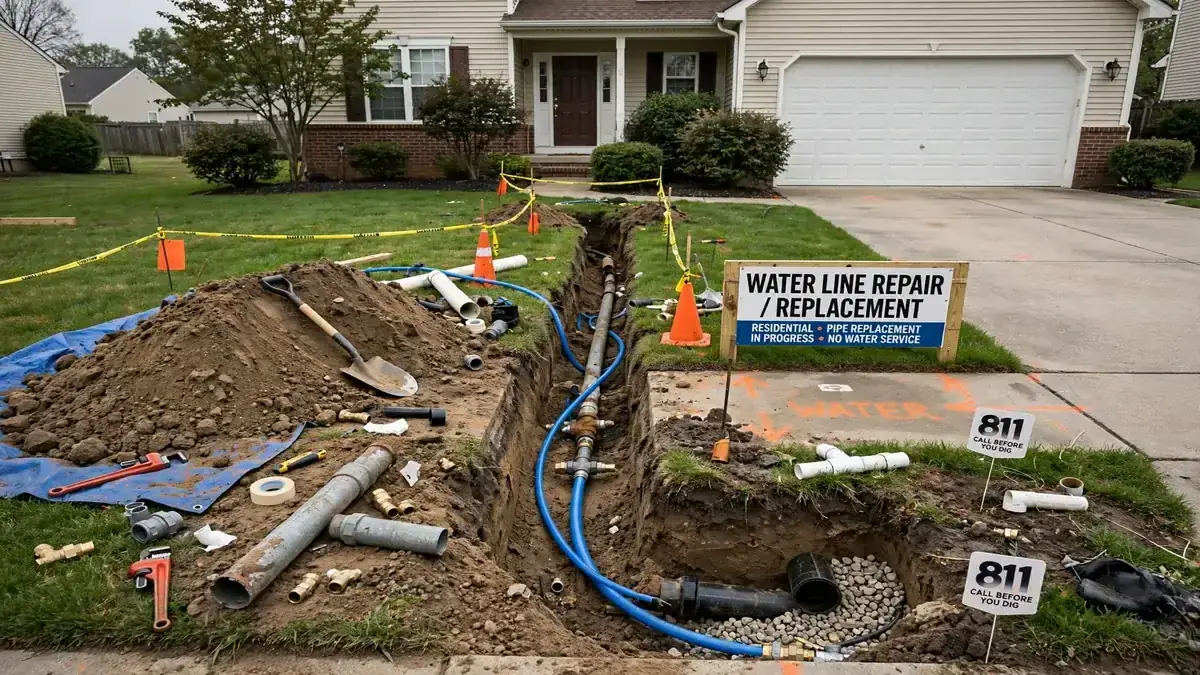
Service line failing right now?
A water service line leak can run for days out of sight, then turn a yard into a sinkhole or a basement wall into a waterfall. Someone answers our phone 24/7 in Etna, and we start by asking what you can see and where. In the meantime, close the main shutoff inside the house, and if water keeps running, close the curb stop outside with a meter key or a pair of pliers if it is accessible.
A water service line is the buried pipe that carries water from the main in the street, or from a well, to your house. Leaks on it can show up as a wet lawn, a pressure drop, or a bill that makes no sense.
If water is rising near the foundation or entering the basement, move belongings away from walls and keep out of rooms with wet outlets. Same-day appointments are available when the schedule allows.
Inside main first
Close it, then check the meter. If it stops, the leak is inside the house. If the dial keeps moving, the leak sits on the service line.
Watch the meter
A dial spinning with all fixtures off is the clearest sign that the buried line is leaking.
Mark the wet spot
A flag or stake in the yard helps us start in the right place. Do not dig yourself near buried gas, electric or utility lines.
The line from the meter to the house, and who owns what
A typical service line runs from a connection at the main, through a curb stop and meter, then underground to the house where it enters near the foundation. The pipe material varies by age and may be copper, galvanized steel, plastic, or in very old systems lead.
Responsibility is divided between the utility and the homeowner, and the dividing line is not the same in every system. Ask your water utility where its part ends and yours begins before any digging starts. A leak on the street side is typically a call to the utility, and one on the house side is yours. On a private well, the whole line is yours.
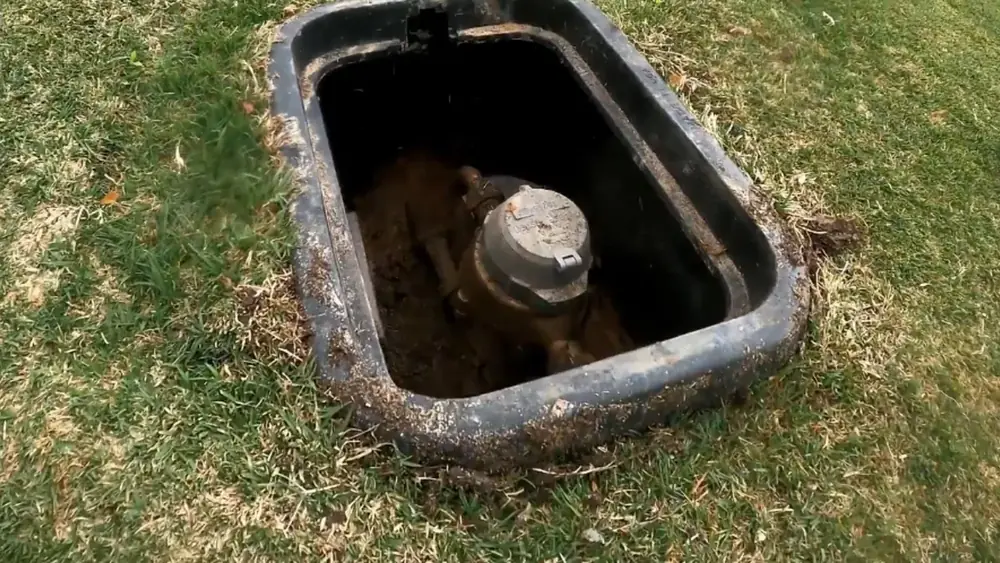
Signs the service line is leaking
Most signs are indirect because the pipe is buried.
Wet or sunken ground
A soft area, lush grass in a dry month, or a dip along the line's path often marks the leak. Water can travel along the pipe trench, so the wet spot can be some distance from the break.
Meter moving with the house off
Closing the house main and watching the low-flow dial is the standard check. Leak detection takes it further by pinpointing the spot.
Pressure falling at every tap
A sudden pressure drop through the whole house, not just one fixture, suggests the line itself.
High bill, no explanation
A usage jump that does not match your habits is worth a meter test.
Muddy or discolored water
Silt entering through a crack, or rust from a failing galvanized line, can come through the taps.
Low water pressure: service line, regulator or something inside the house?
Low pressure has several causes, and only some of them are the service line. A pressure gauge on an outdoor hose bib gives us a baseline reading before we decide where to look.
If the pressure is low at every tap, we check the main shutoff and the pressure regulator first, since a half-open valve or a worn regulator causes the same symptom. If pressure is fine at the meter side and poor in the house, corrosion inside old galvanized pipe may be the cause, and repiping is the real fix. If pressure falls only when you run several fixtures, a narrowed or partly failed service line is the likely culprit.
If only one faucet is weak, the problem is local to that fixture, usually a clogged aerator or cartridge, and does not involve the service line at all.
Open trench versus trenchless replacement
Both methods replace the pipe. The choice depends on what is above it and how long the run is.
| Factor | Open trench | Trenchless (pipe pulling or bursting) |
|---|---|---|
| Access | Digs the full length of the line | Digs an entry pit at each end |
| Lawn, patio and driveway | More surface to restore | Far less surface disturbance |
| Obstacles | Can go around or past roots, rocks and other utilities | Can struggle where the soil has rocks or the old line has sharp bends |
| Inspection | Pipe and connections are visible during the work | Connections are made in the pits, the rest is out of sight |
| Best suited to | Short runs, shallow lines, spot repairs | Long runs under landscaping, drives and walks |
We recommend one after looking at the route. Permits and utility locating (calling before you dig) can apply to either method.
Think the buried line has failed?
Describe the wet spot or the meter behavior and we will help you decide whether it is time for a visit.
Lead and galvanized service lines
Older service lines may be galvanized steel, which rusts from the inside and chokes the flow, or lead, which was used decades ago. Lead is soft, dull gray and scratches to shiny silver, and a magnet will not stick to it. Do not rely on a scratch test alone.
Many water utilities keep records of what each service line is made of, so ask yours. If a line is lead or galvanized, replacing the portion you own is often the cleanest answer, and the utility may handle its half separately. We will tell you what material shows at the entry point and the meter.
Before we dig: what to locate and confirm
- Where the line enters the house and where the main shutoff sits
- Where the meter or curb stop is, and whether the lid opens
- What your utility says about the ownership boundary
- Whether any irrigation lines, fences or trees sit along the path
- Whether the utility-locating service has marked other buried lines
- How you want the surface restored: sod, gravel, concrete or pavers
Before anyone digs a service line in Etna Township
Four local points shape how a buried-line job starts. For a split inside the house, see burst pipe repair instead.
Call Ohio 811 first
OHIO811 asks for notice at least two working days before digging, so any repair that needs a trench has to allow for that wait. Closing the shutoff is what buys you the time.
Start at the meter
The Licking Regional Water District supplies public water here, and its inspectors are on call 24 hours for emergencies. Water gushing on the street side of the meter is theirs to handle. Anything between the meter and your foundation is ours to locate.
The lead question
The district's 2025 water report lists no lead service lines, and its lead and copper samples came in under the action levels. That cannot vouch for any single house, so the visible pipe at your entry point still deserves a look.
Private wells
The Licking County Health Department regulates private water systems, and a permit is needed to install or alter a well. Our work on a well home stops at the house side. The pressure tank and pump go to a well contractor.
Backflow and contractor rules
The district runs a backflow prevention program and keeps a page of licensed contractors. If the job touches the connection at the meter, ask the district what it requires before the trench opens.
Water service problem right now?
Tell us which side of the meter looks wet and what the dial is doing. The phone is staffed day and night.
Frequently asked questions
Night and weekend calls reach a person, not a recording. Start with the meter: tell us whether the dial moves with the house main closed, how wet the yard is and how the pressure looks, and that settles what to shut off. A gushing break goes to the front of the line, and same-day visits are offered when open. A break on the street side also needs a call to the district.
Check the meter first. If the water is on the street side of it, call the Licking Regional Water District, whose inspectors are on call 24 hours for emergencies. If the wet ground or the dial points to the pipe between the meter and your house, call us. Unsure which side it is? Phone either way, and we will talk through what you see and which side it points to.
Ask your water utility where its responsibility ends. The meter is often the dividing point, though not always. A leak on the street side of the meter is usually the utility's, and one between the meter and your house is typically yours. A private well makes the whole line yours.
Sometimes. A spot repair needs a hole at the leak. A full replacement can use trenchless methods that dig entry pits at each end and pull new pipe through, which disturbs less lawn. We explain which method fits your route before work starts.
It may be the service line, a partly closed valve, a worn pressure regulator, or corroded galvanized pipe. A gauge at an outdoor spigot helps sort that out. Weak pressure at one fixture is usually a local clog and not a service line issue.
It depends on where you live and where the digging happens. Some jobs need a permit, and work in a public right of way may involve the utility. Check with your township or county building office, and we will tell you what applies once we have seen the route.
A scratch on bare pipe will show shiny silver if it is lead, and a magnet will not stick. Only visible pipe near the meter or entry can be checked this way. Call your water utility, which may have records for your address.