
Sewer backup: what to do first
Sewer line cleaning means opening the main drain that carries every fixture's waste out of the house. When sewage comes up through a floor drain or tub, a person answers our line 24/7, and the steps below limit the damage before we get there.
A sewer backup is a health matter as well as a plumbing one, since the water carries bacteria. Keep children and pets out of the area and avoid touching standing water without waterproof gloves.
Stop all water use
That includes toilets, showers, washers and dishwashers.
Keep people out
Close off the room with the backup and do not wade through it barefoot.
Switch off power if water is near outlets
Only do this if you can reach the panel without standing in water.
Leave the cleanout capped
Do not open it yourself, since a full line can spill out under pressure.
Find your cleanout before we arrive
The cleanout is the capped pipe that gives a machine direct access to the main. Check these places.
- Basement floor, usually near where the main leaves the house
- Crawlspace wall or floor near the foundation
- Outside the foundation, a capped pipe in the ground near the side of the house
- Utility room or garage, sometimes a Y-fitting with a threaded plug
- Near the lowest bathroom if the house has a slab, since lines often exit near the bath group
Main line or a single branch
A main line problem and a branch problem look different if you watch which fixtures complain.
Multiple fixtures slow at once
Water from different branches meets at the main. A blockage there slows everything.
Floor drain or lowest tub backs up
These sit lower than other fixtures, so they overflow first.
Toilet gurgles when the washer drains
Displaced air is looking for a way out past a blockage.
Sewer smell in the basement
Gas rising from a dry trap or a partial blockage. A camera tells which.
Wet spot in the yard over the line
Sewage is escaping a crack or a bellied section and soaking the ground.
Cleaning the main sewer line
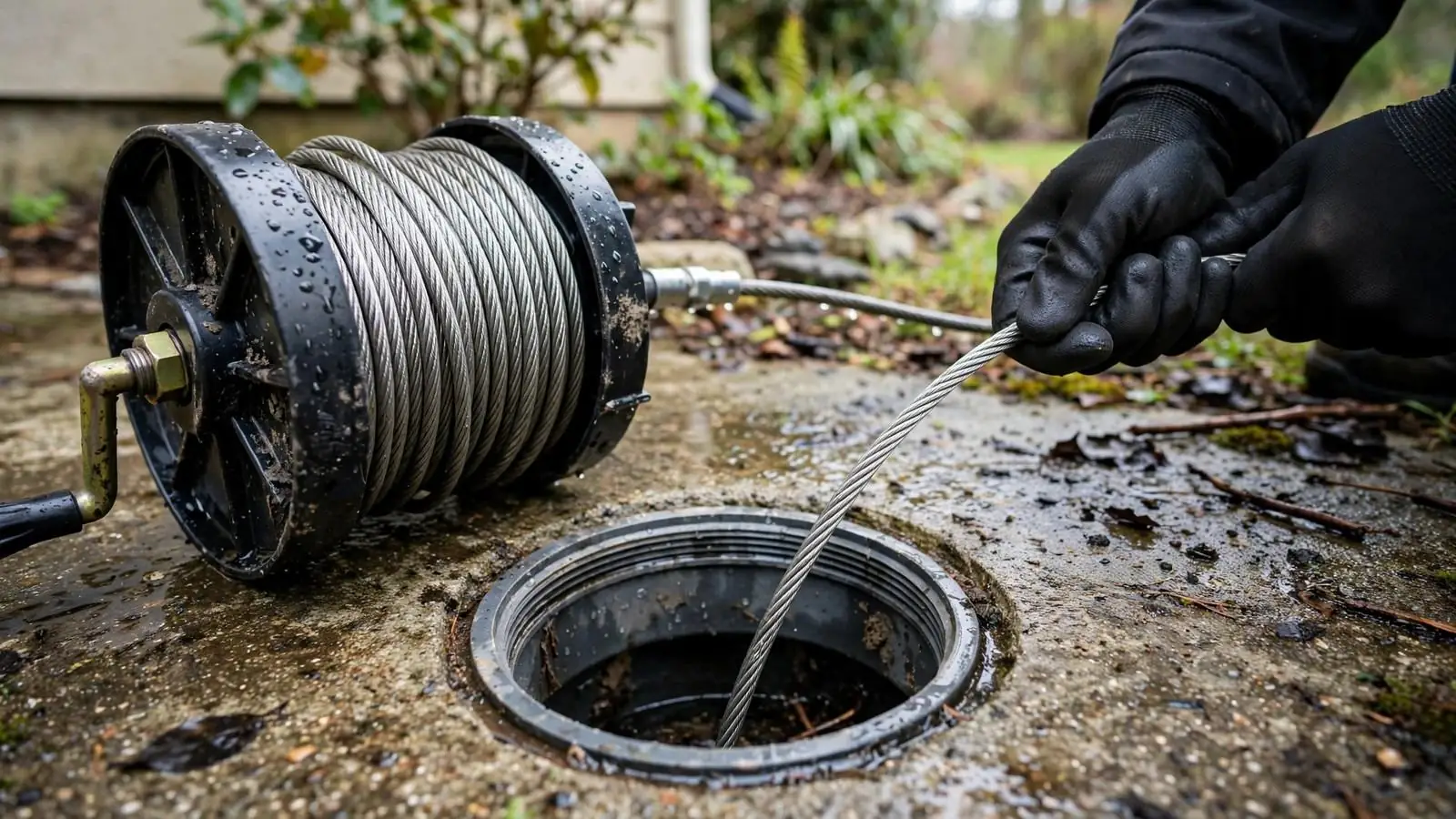
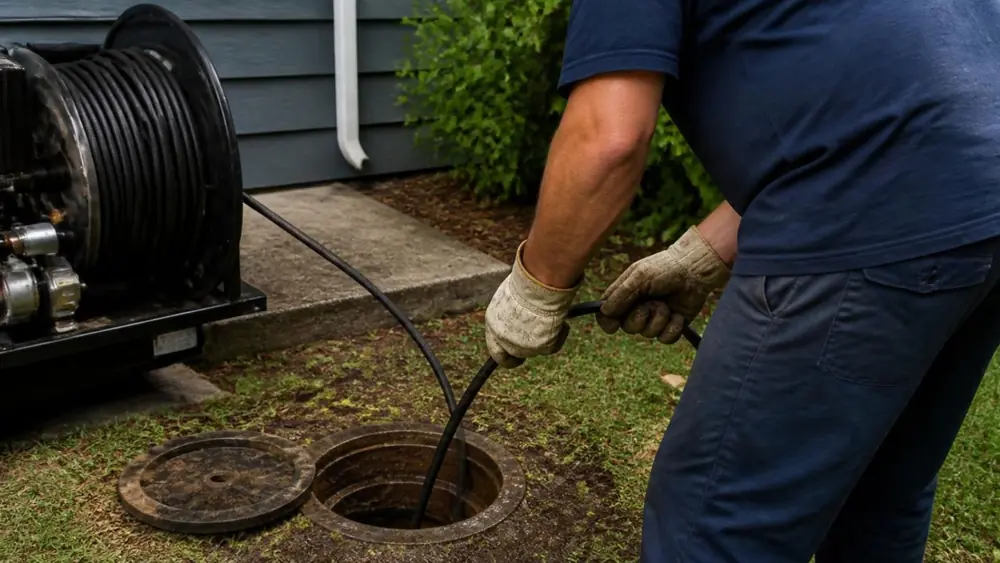
Main sewer cleaning uses a larger drum machine with a heavier cable than a sink machine, or a hydro jetter, fed through the cleanout. The cutter head is chosen for the pipe size and what we expect to meet, whether grease, paper or roots.
We work toward the blockage slowly, then clear it and flush the line with full water flow to confirm it drains freely. If the cable brings back root tissue, a heavy paper clump or a scale-laden cutter, the debris tells us why the line plugged.
A line that is open is not necessarily healthy. After clearing, we suggest a camera look through sewer inspection whenever the blockage was roots, a recurring problem or a house you have just bought.
Reading what comes back on the cable
The debris on the cutter is a clue. Here is how we interpret it.
| What we see | What it usually means | Next step |
|---|---|---|
| Thick grease and soap | Kitchen or laundry habits, a pipe wall coated for years | Hydro jetting and a change in disposal habits |
| Wet wipes and paper in a mat | Flushed items that do not break up, or a low spot catching solids | Clear, then camera to look for a sag |
| Fine roots, hair-like | Roots entering at a joint | Clear, camera, and plan on a repeat cleaning schedule |
| Thick woody roots or soil | Joint failure or a break | Camera and sewer line repair options |
| Flakes of rust or scale | Iron pipe aging from inside | Camera to judge remaining wall thickness |
Deciding between a one-off cleaning and a schedule
A main that plugs once after a flushed towel needs one cleaning and a change in habits. A main that plugs every spring is a maintenance question: how often to clear it, and when to stop clearing it and look at the pipe.
We ask when the last two blockages happened and what came back on the cable, then suggest an interval that matches. Two cleanings in a year on the same line is the usual point to add a camera look, because a third cabling rarely teaches you anything new.
Sewage coming up through a drain?
Tell us how many fixtures are affected and where the cleanout sits, and we will explain what to do until a visit is arranged.
What happens on the visit
- 1
Walk through symptoms
Which fixtures, how long, what was flushed or poured recently.
- 2
Locate and open the cleanout
Relieve pressure slowly with a bucket and towels on hand.
- 3
Clear the blockage
Cable or jet, depending on what the line is carrying.
- 4
Confirm flow
Run water at the fixtures and watch the cleanout for steady discharge.
- 5
Recommend what comes next
That may be nothing, a routine schedule, or a camera look.
When the backup is not a clog
On a septic system, sewage can rise because the tank is full or the field is saturated, and no cable will fix that. We clear the pipe between the house and the tank. We do not pump septic tanks or repair them, and a septic service has to handle that part.
Tell us which kind of system you have when you call, so we know whether to bring a machine or point you elsewhere.
High-water days in Etna and what they mean for your main
NOAA's storm record lists several high-water days in the township, and central Ohio averages about 41.6 inches of precipitation a year (Columbus airport normals). Soil at our Etna address is Cardington silt loam, a moderately well drained glacial till, so groundwater can rise after a hard rain. A backup that follows a storm deserves a different question than a backup in dry weather.
| Documented event | What it can do to a sewer line | What to do |
|---|---|---|
| 20 June 2015, Purity Road closed by high water | Saturated ground can push groundwater into a cracked or open joint | Note the date of any slow drains after a storm and mention it on the call |
| 17 Feb 2022, Watkins Road SW near Creek Road SW closed by high water | Rain on thawing ground loads the soil around the pipe in winter | If the clog returns after each wet spell, ask for a camera look instead of a repeat cleaning |
| 25 June 2025, high water over York Road | Heavy summer rain can overload a line that is already restricted | Clear it before the next big storm, not after |
Homes in Pataskala, Kirkersville and Reynoldsburg get the same weather. The records show road closures, not sewer failures, so treat the table as a prompt to check, not a diagnosis.
Frequently asked questions
Sewage in a tub or floor drain is exactly the call a person answers at any hour, nights and weekends included. We schedule the next opening for a same-day or overnight visit. Until then, run no water, keep people and pets out of the affected room, and leave the cleanout capped.
A floor drain sits near the lowest point of the plumbing system, so it is the first place water goes when the main line is blocked. Several fixtures running at once usually confirms the blockage is in the main.
Only when it shows symptoms, for most houses. A line with roots or a sag may need periodic cleaning, and a camera inspection tells you what schedule makes sense.
We recommend against it during a backup. A full line can push sewage out of the opening under pressure, and the cap may be hard to thread back on. Leave it capped and let us open it with the right gear.
Policies differ on sewer backup coverage, and many require an add-on. Ask your insurer before you rely on it, and take photos of any water damage with the time you noticed it.
The Licking Regional Water District supplies public water and sewer in the area, so it is the office to ask. We cannot tell from the street which addresses are sewered. If yours is not, the house is on a septic system, which the county health department's Sewage Treatment Program oversees, and the cleanout we find leads to a tank. We clear the house side only.