
What boiler repair covers here
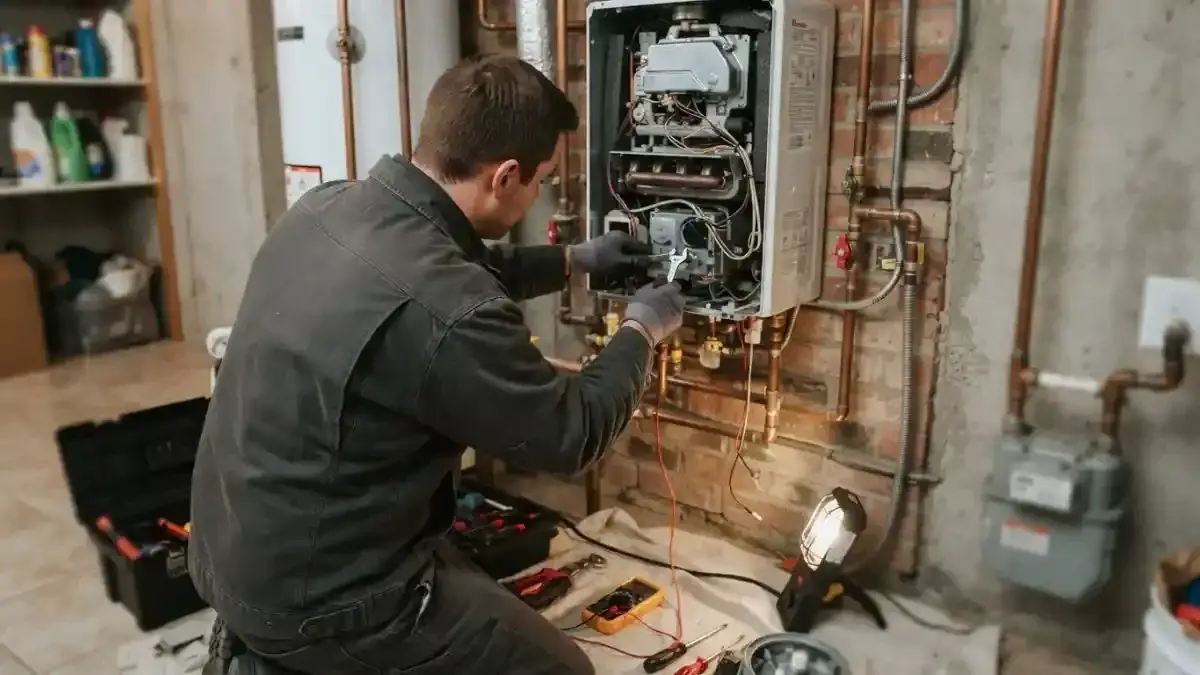
Boiler repair is the diagnosis and fixing of the water, pressure and piping side of a heating boiler: leaks, valves, circulator pumps, expansion tanks, air in the lines, and the pipework to radiators or baseboards. We work on hot water boilers and on steam systems. Where a fault sits in the burner controls or a sealed manufacturer part, we tell you rather than guess.
Boilers heat a house by moving hot water or steam through a closed loop, which is why a small leak or a bad valve can cost you the whole system. If the issue is hot water for taps rather than heat, water heater repair is the better page.
If you smell gas, leave first
A rotten-egg smell or a carbon monoxide alarm means leave the building, then call the gas utility or 911 from outside. Do not turn lights or switches on or off, and do not call a plumber before you are out. Once the utility clears the building, we can look at what failed.
Four boiler problems we see most
Most service calls fall into one of four groups. Naming yours helps us bring the right parts.
No heat
The boiler runs but rooms stay cold, or it does not fire at all. Causes include a failed circulator, a stuck zone valve, air trapped in the loop, or a safety lockout.
Leaks
Drips at a relief valve, a pump flange, a radiator valve or a pipe joint. A leak that drains pressure usually calls for a quick look because the system can shut down on low water.
Pressure swings
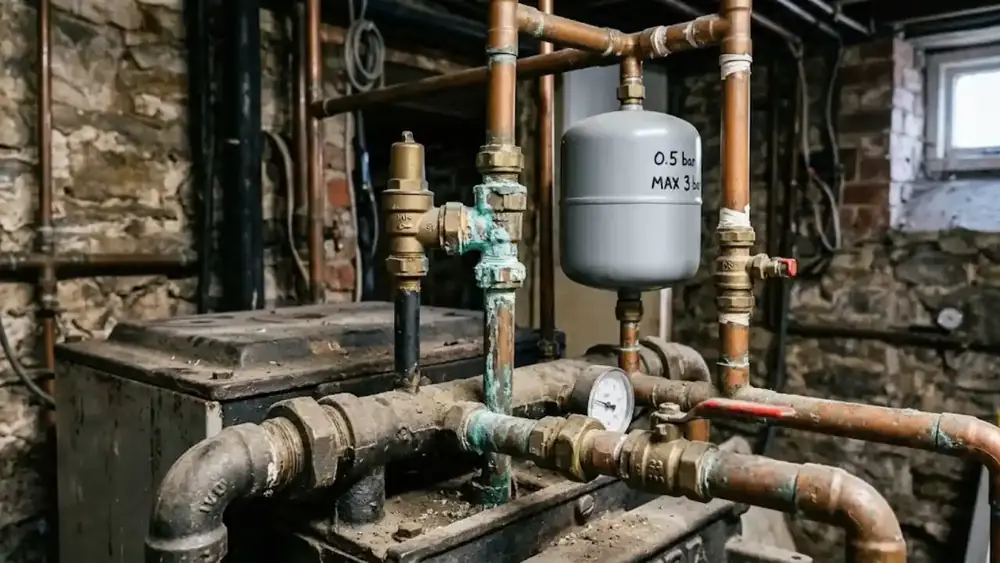
Pressure that keeps climbing or dropping points at an expansion tank, an auto-fill valve or a leaking relief valve.
Noise
Banging, gurgling or kettle sounds suggest trapped air, scale, low water or water hammer in steam piping.
Hot water boilers and steam boilers
They look similar from the basement but behave very differently, and so do their problems.
| Feature | Hot water (hydronic) | Steam |
|---|---|---|
| What carries heat | Heated water pumped through baseboards or radiators | Steam rises to radiators and condenses back to water |
| Normal pressure | Often around 12 to 15 psi when cold | Well under that, usually just a few psi |
| Key parts | Circulator, expansion tank, zone valves, air vents | Sight glass, low-water cutoff, radiator vents, return lines |
| Common faults | Air in the loop, failed pump, pressure swings | Low water, clogged vents, banging pipes |
Check your boiler's own gauge and manual. Normal readings vary with the system.
How we work through a no-heat call
- 1
Check the basics
We confirm thermostat calls, power to the boiler, water level or pressure, and whether the unit is locked out.
- 2
Read the pressure and flow
Gauges tell us if the system is low, high or air-bound. We bleed radiators or purge zones if air is the cause.
- 3
Test pumps and valves
We feel for flow, test the circulator and zone valves, and look at the expansion tank and relief valve.
- 4
Repair or hand off
Plumbing-side faults get repaired. If the cause is in the burner controls, the heat exchanger or a sealed part, we tell you and explain the next step.
Cold house and a boiler that will not cooperate?
Call and describe the symptoms. Someone answers the line, and we fit you in when the schedule has room.
What we handle, and what belongs elsewhere
A clear scope saves you a wasted visit.
Plumbing-side work we do
- Leaking valves, pump flanges and pipe joints.
- Circulator pump and zone valve replacement.
- Expansion tank, fill valve and relief valve problems.
- Bleeding air from radiators and purging zones.
When it is HVAC or manufacturer territory
- Burner, ignition and combustion tuning.
- Cracked heat exchangers or sealed control boards.
- Warranty claims and factory-only parts.
- Whole-system replacement planning, which we can discuss but may refer out.
Parts we replace most often
Circulator pump
The pump moves hot water through the loop. A noisy, hot or silent circulator often explains a cold house.
Expansion tank
A waterlogged tank lets pressure spike, which opens the relief valve and loses water.
Relief valve
A valve that has opened repeatedly may no longer seat. It is a safety device, never to be capped.
Air vents and zone valves
Vents release trapped air and zone valves direct heat room to room. Either one stuck can leave a zone cold.
Before you call: what to note
These details cut the diagnosis time.
- The type of boiler: hot water or steam, and the fuel it burns.
- What the pressure gauge reads and whether it has changed.
- Which rooms are cold and which are warm.
- Any error light or display message on the boiler.
- Whether water is dripping and from where.
Heat, fuel and cold snaps in Etna Township
We work in Etna and the neighboring towns of Pataskala, Reynoldsburg and Kirkersville. These local numbers shape how we approach a boiler call.
Fuel mix
Of about 7,100 occupied township homes, roughly 5,100 heat with utility gas, 1,500 with electricity, 300 with LP gas and 130 with fuel oil. Tell us which yours is, because a fuel smell goes to the gas utility, LP supplier or oil dealer first.
Housing age
Most homes were built from 1990 to 2009 and only about 290 predate 1940. If yours is one of the older houses, ask us to look at the whole loop, since old radiators and pipe wear together.
Cold events
Wind chills ran 20 to 40 degrees below zero on 30 January 2019 and fell colder than 25 below on 22 December 2022. A pressure and circulator check before a night like that is cheaper than a frozen line, and burst pipe repair covers the aftermath.
Long season
The Columbus airport station records about 103 days a year at or below 32 F. A boiler runs most of that stretch, so slow leaks and weak pumps show up quickly.
Frequently asked questions
Many home hot water boilers sit around 12 to 15 psi when cold and rise somewhat when hot. Your boiler's gauge and manual set the real range. Pressure that keeps rising or falling points at an expansion tank, fill valve or leak.
A person answers our line 24/7 and we offer same-day appointments when the schedule allows. We cannot promise a time. Meanwhile, close doors to unused rooms, open cabinet doors on exterior walls and use safe space heaters. Never use an oven or a fuel-burning heater indoors for warmth.
Trapped air is the usual cause on hot water systems, and bleeding radiators or purging zones often solves it. Kettle sounds point to scale and low water. In steam systems, banging can come from pipes that do not slope back to the boiler.
Some systems have a fill valve you can open slowly to bring pressure up to the normal range. If the pressure keeps dropping, there is a leak and adding water only hides it. We find and fix the source.
Yes, for the plumbing side: water level, vents, return lines and piping problems. Combustion and control-board faults may need an HVAC specialist or the manufacturer.
For a fuel smell, an empty tank or a delivery question, call your LP supplier or oil dealer first. About 430 township homes heat with one of those fuels. Once the fuel side checks out, we take the water, pressure and piping side, including leaks, pumps and valves.