
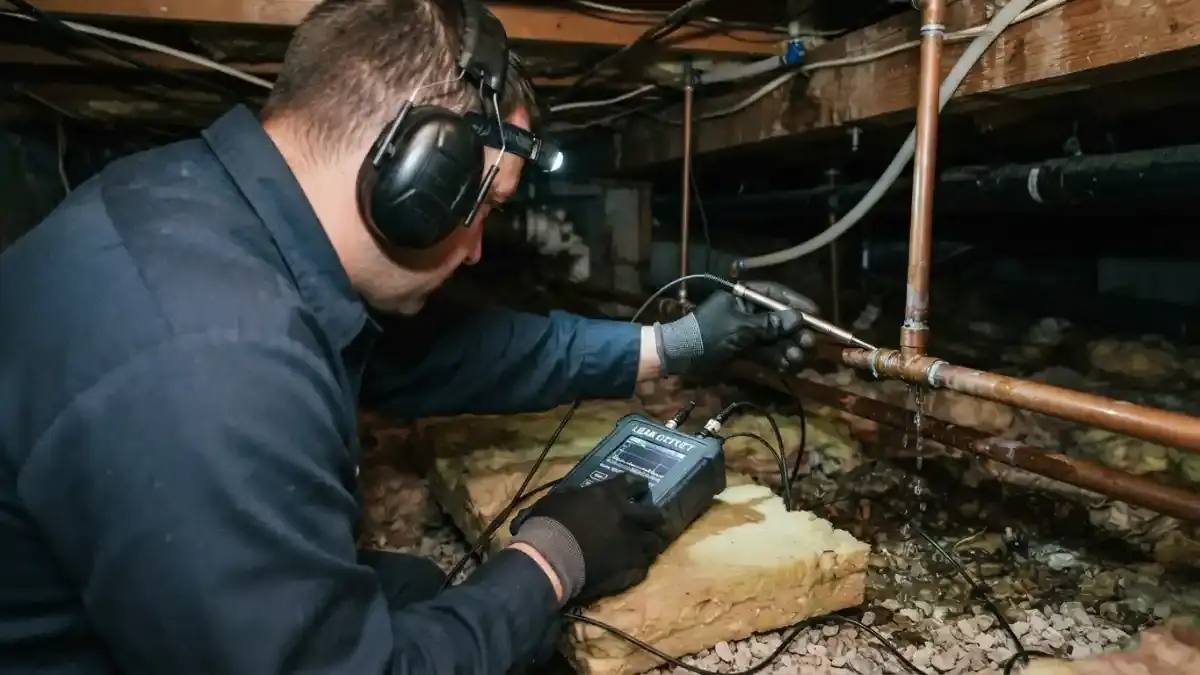
When a hidden leak is an emergency
Water showing up where it should not be is urgent, and a person answers our line 24/7 in Etna. An active ceiling drip, a wall that keeps getting wetter, or a meter that spins with every fixture off all count. While you wait, close the main shutoff valve, usually found where the line enters the house near the water heater or meter.
Leak detection is the work of locating where water escapes from a pipe by measuring and listening, so the repair opens a small spot instead of half a room.
If water is near a light fixture, outlet or panel, keep everyone away from that area. After-hours and weekend calls get the same treatment as daytime ones: we ask what you see, tell you what to shut off, and book the earliest appointment that fits.
Close the main
Turn the main valve clockwise until it stops. If water keeps flowing afterward, the leak may sit upstream of the valve, on the line from the meter.
Photograph it
Take dated photos of stains, puddles and the meter face before anything dries. They help if you later talk to your insurer.
Clear the area
Move rugs and electronics off wet floors. Keep kids and pets out of rooms with water pooling in a ceiling fixture.
How a leak gets found without tearing the house open
Most leaks are found by narrowing the problem in stages: is water escaping, is it supply or drain, hot or cold, and which stretch of pipe. By the time we reach the listening or thermal step, the search covers a few feet instead of the whole building.
A pressure gauge on a hose bib shows whether the closed system holds. A drop points to a pressurized supply leak. A steady reading sends us toward a drain, a fixture, or condensation instead.
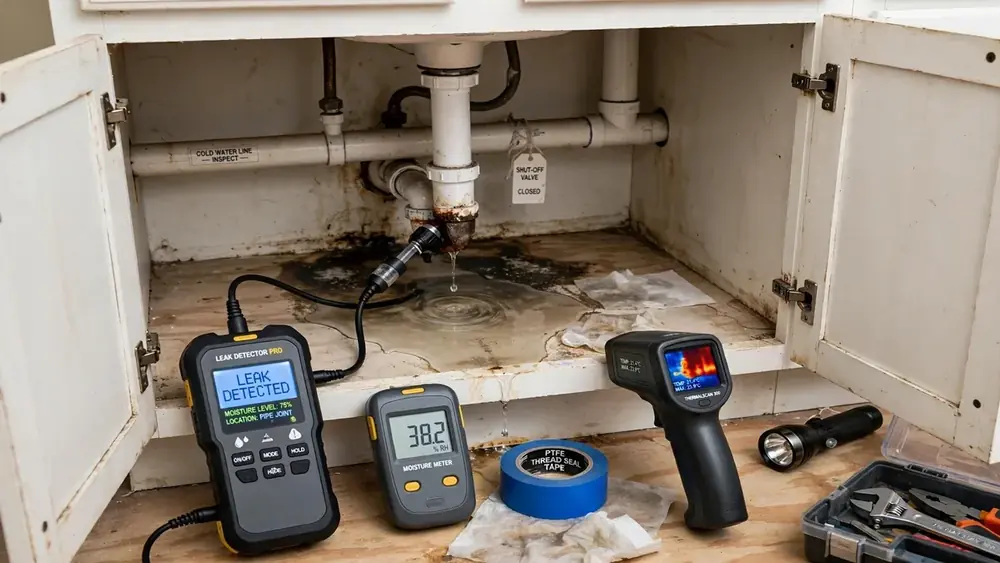
Leak detection methods and what each one can tell you
No single tool settles every case. We combine them, and each has things it cannot do.
| Method | Best at | Limits |
|---|---|---|
| Meter test | Proving that a supply-side leak exists | Says nothing about where it is |
| Pressure test | Splitting hot from cold, or one zone from another | Needs a way to cap or isolate sections |
| Acoustic listening | Pinpointing leaks under slabs and inside walls | Plastic pipe, low pressure and street noise muffle the sound |
| Thermal imaging | Hot-water leaks, wet insulation, heated-floor lines | Cold-line leaks show weakly |
| Moisture meter | Mapping how far water has spread in drywall and wood | Shows wetness, not the source |
| Tracer gas | Small leaks too quiet to hear | Slower, because the pipe must be emptied and refilled |
| Camera | Drain lines and open wall cavities | Cannot see inside a pressurized supply pipe |
Run a meter test at home before you call
A meter test shows whether water is leaving the house when nobody is using it. It takes patience and nothing else.
- 1
Stop every use
Shut off the ice maker and irrigation controller, and make sure no tap, toilet or washing machine is running. A softener mid-regeneration also draws water.
- 2
Find the meter
It sits in a box near the curb or inside the basement or utility room, depending on how the line enters. A home on a private well has no utility meter, so tell us that on the phone and we will use a pressure-drop test instead.
- 3
Read the low-flow dial
Most meters carry a small triangle or star that turns with even a trickle. If it moves while everything is off, water is escaping somewhere. Write down the main digits too.
- 4
Wait, then read again
Leave everything off for 30 to 60 minutes, or overnight if you can. Any change in the digits means a leak.
- 5
Close the house main and repeat
Shut the main valve inside the house and watch the dial. If it stops, the leak is inside. If it keeps moving, the leak is on the buried line between the meter and the valve.
Meter still moving with everything off?
Tell us what the dial is doing and where the meter sits. We will say what to check next and book the visit.
Slab leaks: warm floors, running-water sounds and hot-side losses
Pipes under a concrete slab leak out of sight. The first clues are a warm patch of floor, water running in a quiet house, or a water heater that seems to run constantly. A hot line gives itself away because the leak heats the concrete above it. A cold-line slab leak can stay silent for months and show up only as a meter that moves overnight.
Pressure tests on each line separately halve the search, and acoustic equipment plus a thermal scan then mark the spot closely enough for a small access hole. Repair means breaking the slab at the leak, rerouting the line overhead, or replacing a line with several failures, which is where repiping comes in. We lay out the choices before any concrete is cut.
Ceiling and wall leaks: where the water shows up is not always where it starts
A stain is a clue, not an address.
Brown ring on a ceiling
A ring with a darker edge means water has arrived, dried and arrived again. The source often sits several feet away along a joist.
Bubbling paint or soft drywall
A moisture meter maps the damp zone. The wettest point is not always the leak, so we test the nearest pipes.
Hissing at night
A hiss in a quiet house points to a pressurized line. Dripping that follows only a shower points to a drain, a tub overflow or a loose shower valve.
Stains after rain only
These usually come from the roof, flashing or siding, not plumbing. Ruling plumbing out is a legitimate result, and we will say so.
Under the house and in crawlspaces
Crawlspaces and unfinished basements let us see the pipes directly. We check supply and drain lines for drips, mineral crusting, rust at fittings and insulation sagging between the joists, and a pressure test confirms which line is involved.
Cold pipes sweat in humid summer weather and can look like a leak, so we check whether the dripping follows the weather or follows water use. Condensation is fixed by insulating the pipe. Water seeping through walls or floor is a drainage question, covered under basement waterproofing.
Buried line leaks between the meter and the house
The underground supply line is invisible, so the signs are indirect: a soft or unusually green patch of lawn, a low spot that stays wet in dry weather, a drop in pressure at the taps, or a meter that moves with the house main closed. Central Ohio freeze-thaw winters shift soil and stress joints, so these leaks often surface in late winter or spring.
Closing the house main tells us the leak is outside. Ground microphones then follow the line until the sound peaks, and we mark the spot before anyone digs. Repair is covered on the water service line repair page.
Irrigation, pool and meter-box leaks
These sit outside the walls and are easily mistaken for a house leak.
Irrigation systems
A stuck zone valve or broken head can move the meter like a leak indoors. Close the irrigation supply and see if it stops. We can tell you which zone is at fault, though heads and controllers may belong to an irrigation contractor.
Pools and spas
We pressure test the supply and return plumbing. A leak in the shell or liner is outside our work, and we will say so if the test comes back clean.
Meter boxes
A wet box can mean a weeping connector on your side of the meter or the utility's. Photograph it, and we can identify which fitting is wet.
Where the district's pipes end and yours begin
Public water and sewer in Etna Township come from the Licking Regional Water District, which keeps inspectors on call around the clock for emergencies. For a meter test that matters: water escaping on the street side of the meter is a call to the district, while water between the meter and your walls is what we trace. Write down the time and the dial reading before you phone anyone.
Homes on a private well fall under the Licking County Health Department instead. The Ohio EPA source water assessment for the district's wells calls its aquifer highly susceptible because it is shallow, under 10 feet, with no protective clay layer. That is a reason to fix a leaking fitting near any wellhead promptly and to test the water afterward. We take leak calls in Pataskala, Kirkersville and Reynoldsburg too, so say which town and whether you have a meter.
Water going where it should not?
Describe the stain, the sound or the dial and we will help you decide what to shut off first, any hour of the day.
Frequently asked questions
A bill that creeps up with no change in habits, a meter that moves with everything off, a musty smell or warm floor patch, and water sounds in a quiet house are the usual signs. Any one is worth a meter test.
A person answers at every hour, weekends and holidays included. Tell us what you are seeing and we will talk you through closing the main and reading the meter, which shows whether the water is escaping inside or outside the house. The earliest open appointment is booked from there, same-day when the schedule allows.
Often, yes. Pressure tests, listening gear, thermal imaging and moisture mapping narrow most searches to a small area. If an opening is still needed, we mark the smallest one that reaches the pipe and explain it before cutting.
Yes, in most cases we repair what we locate, from a fitting under a slab to a section of supply line. Some repairs need a permit, and we will tell you which. If the cause is the roof or the utility's side of the meter, we say so.
Do the at-home meter test described above. If the dial moves with everything off, water is leaving the house and the bill is probably correct. If it stays still, ask your water utility to check their reading and compare the usage dates on the bill with any events like filling a pool or running irrigation.
Yes. There is no meter, so we use a pressure test and watch how often the well pump cycles with every tap closed. A pump that keeps restarting points to water escaping somewhere in the system. The listening and thermal steps afterward are the same as for a home on a utility line.