Toilet overflowing or leaking right now?
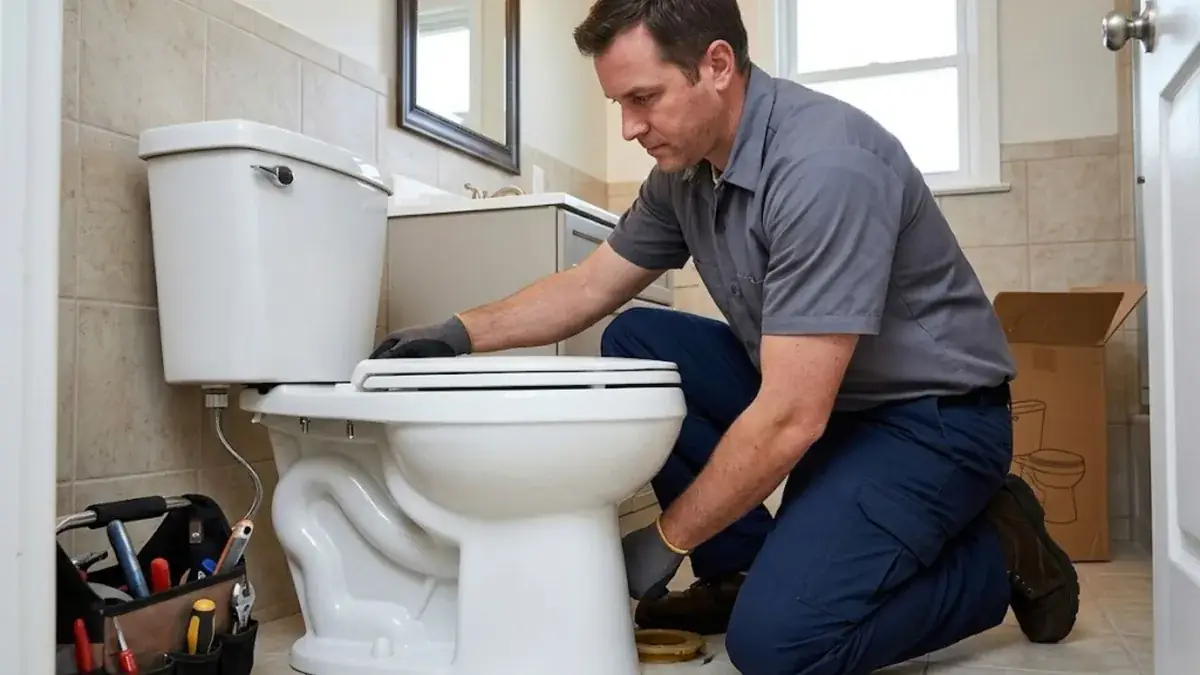
An overflowing toilet can push water through a bathroom subfloor in a few minutes, so stop the flow before anything else. A person answers our line 24/7, and while you wait you can turn the chrome stop valve behind the bowl clockwise until it will not turn further. If the bowl keeps filling, lift the tank lid and press the rubber flapper down into its seat to cut off the tank.
Hold off on the plunger until the water level stops rising. Towels around the base buy time, and a wet vac clears a tiled floor faster than a mop. Whatever failed, the next step is working out whether the problem sits in the toilet itself or in the drain below it.
Stop the supply
Quarter turn or full turn clockwise on the stop valve, low on the wall or floor behind the bowl. Hand pressure only, since an old valve can snap.
Keep people off the floor
Water that has reached an outlet strip or a floor fan is an electrical hazard. Unplug from a dry spot or leave it and switch off the bathroom breaker.
Do not flush again
Each flush on a blocked line sends another 1.6 gallons or more into the bowl. Wait until someone has looked at the drain.
What your toilet is telling you
Most toilet calls fall into a handful of patterns. This table matches the symptom to the part that usually fails and the work that follows.
| Symptom | Usual cause | What the repair involves |
|---|---|---|
| Water trickles into the bowl for minutes after a flush | Worn flapper or a chain with too much slack | New flapper and chain adjustment, often under half an hour |
| Tank refills with a hiss, then refills again hours later | Fill valve not shutting off or a leaking flapper | Replace the fill valve, test with food coloring in the tank |
| Puddle at the base after every flush | Failed wax ring or loose closet bolts | Pull the toilet, inspect the flange, set it on a new seal |
| Water beads on the outside of the tank | Condensation on a cold tank in humid weather | Usually no repair, sometimes a tank liner or mixing valve |
| Weak flush, bowl rises, slowly drains | Partial clog or blocked rim jets | Auger the trap, clean the jets, check the vent if it recurs |
| Gurgling after flushing, other drains slow | Clog further down the line | Treat as a drain problem, see drain cleaning |
| Rocking on the floor | Loose bolts or a flange sitting below the floor | Shim or reset the bowl, repair or raise the flange |
A running or leaking toilet is a mechanical problem. A toilet that will not clear is usually a drain problem.
How we separate a clog from a failed part
The two look alike from the doorway, so the order of checks matters. Skipping straight to a plunger on a mechanical fault wastes time, and replacing parts on a blocked line fixes nothing.
- 1
Check where the water goes
Water that rises in the bowl and drains slowly points at a blockage. Water that never reaches the bowl, or that escapes outside it, points at a part.
- 2
Test the tank
Drop a few drops of food coloring into the tank and wait twenty minutes without flushing. Color in the bowl means the flapper or its seat is leaking.
- 3
Try a closet auger
A closet auger is built to pass the curved trap inside the bowl without scratching the porcelain. If the obstruction is a toy, a wipe or a wad of paper, it usually comes back on the first or second pass.
- 4
Look further down the line
If the auger runs free but the bowl still gurgles, we check a second fixture. Two slow fixtures at once mean the branch line, and that moves the job over to sewer line cleaning.
Toilet down and no second bathroom?
Tell us what the bowl is doing and whether the supply valve will close. We will work out the soonest slot and call back to confirm it.
The running toilet that never quite stops
A toilet that runs on its own is the quietest way to waste water in a house. A worn flapper can leak a steady stream that nobody hears, and the tell is a water bill that creeps up while nothing else changed.
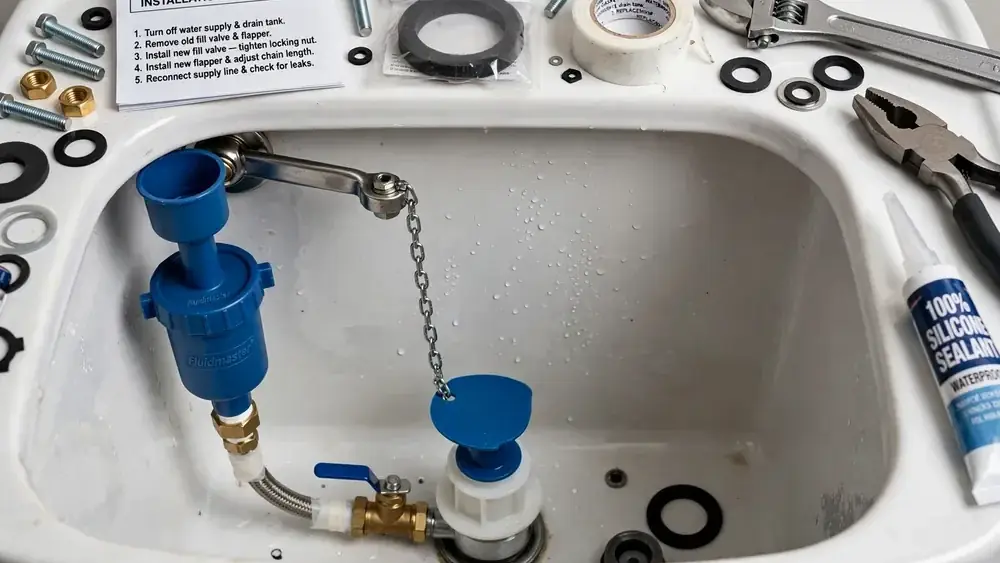
Most cures are small. The fill valve, the flapper, the chain and the flush lever are all replaceable in one visit, and a toilet more than a decade old often benefits from replacing all of them together rather than one at a time.
Seal, flange and bowl: what to leave to a plumber
Replacing a flapper is a fair weekend job. Lifting a toilet is different, because the bowl is heavy, the wax is messy and the flange underneath decides whether the new seal will hold.
Reasonable to try yourself
- Closing the stop valve and checking whether it holds
- Swapping a flapper that matches the tank brand and size
- Tightening the supply line nut a quarter turn by hand and wrench
- Using a plain flange plunger on a slow bowl
Better handled by a plumber
- Rocking or leaking at the floor, which means a new seal and a flange check
- Stains on the ceiling below the bathroom
- A cracked tank or a hairline crack in the bowl
- Repeat clogs, which point at the line rather than the toilet
- A valve that spins without closing
Repair, or put in a new toilet?
Parts are cheap compared with a new bowl, but a repair that keeps coming back is no bargain. These are the points that tip the decision.
Age and cracks
A hairline crack in porcelain or a tank that weeps from its bolts cannot be sealed for good. The toilet itself is done.
Rough-in distance
Measure from the finished wall to the center of the floor bolts. Twelve inches is common, but ten and fourteen exist, and a wrong fit leaves a gap at the wall.
Bowl shape and height
Elongated bowls sit a few inches longer than round ones, and comfort-height models raise the seat. Check clearance to the vanity and door.
Flush design
Gravity-fed tanks are simple and cheap to fix later. Pressure-assist models flush hard but cost more to repair and run louder.
Installing a new toilet
We set the new bowl on a fresh seal, connect a new supply line, check the flange and confirm it does not rock. The old toilet leaves with us. If the flange or subfloor is damaged, we say so before we start.
Sewer, water and permits for a toilet job in Etna Township
Where public water and sewer serve a home in the township, they come from the Licking Regional Water District, so a bowl that gurgles with other drains slow is a question about your line, not the district's.
Replacing a toilet with the same or a similar one in the same spot falls under the exception in the Licking County plumbing rules, so no permit is needed for a straight swap. If the flange moves or new drain piping is involved, a permit and inspections apply, and we tell you which side your job lands on. Neighbors in Pataskala share the same water district.
Frequently asked questions
Yes, a person picks up the line day and night, weekends included. Tell them whether water is still running, whether the stop valve closes and whether any other drain is backing up. Until we arrive, close the valve behind the bowl, mop or vacuum the floor and keep electrical items out of the wet area.
If water rises in the bowl and drains slowly, it is a clog. If the tank refills on its own, the bowl leaks at the base or the handle feels loose, it is a mechanical fault. A quick test is food coloring in the tank: color in the bowl after twenty minutes means a leaking flapper.
Water at the base after a flush usually means the wax ring has stopped sealing against the flange, often because the bowl has loosened over time. Less often, the tank bolts or the supply connection drip down the outside of the bowl. We find which one before touching anything, since a stained subfloor needs a look too.
Most working parts can be replaced inside an existing toilet, including the flapper, fill valve and handle. Replacement makes sense for a cracked bowl, a tank that leaks through the porcelain or a model that clogs constantly. We tell you which applies and let you decide.
Yes. A silent leak from tank to bowl can add up to many gallons a day, and the only sign may be a higher water bill. It also wears the fill valve, which then fails sooner. The fix is usually one visit, and it is far cheaper than months of wasted water.
Most township homes were built between 1990 and 2009, so many toilets are now old enough for their rubber and plastic parts to tire. Expect the flapper, the fill valve and the supply line to go before the porcelain does. A rocking bowl or damp floor at the base points at the seal. None of that is a sign the house is failing.