
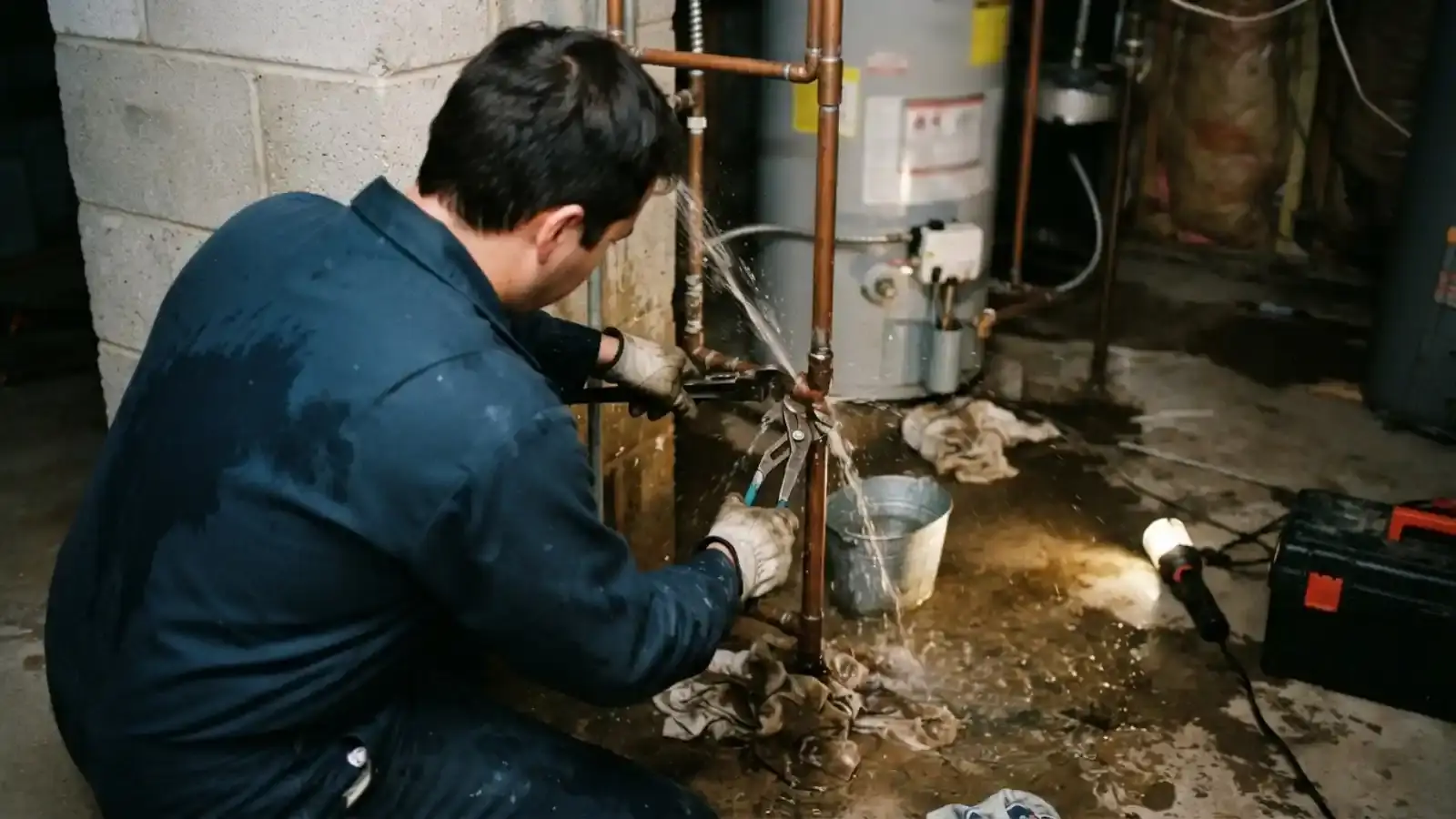
When a burst pipe is an emergency
A split pipe is pouring water into your walls, floor or ceiling, and every minute adds damage. Our line is answered by a person 24/7 in Etna, and the first thing we will ask is whether the main valve is closed. Close it first, then call.
A burst pipe is a pipe that has split, cracked or separated at a joint and now lets water escape faster than a drip. The usual causes are freezing, age and corrosion, and over-tightened or failed fittings.
Once the water is off, open the lowest faucet in the house to drain the lines and relieve pressure. If a ceiling is bulging with water, a small hole in the lowest point lets it drain into a bucket instead of collapsing.
Main valve first
It is usually in the basement, utility room or near the water heater, and turns clockwise to close. If it will not turn, the curb or meter shutoff is the next option.
Power and heater
Switch off the water heater at its breaker or gas control if the tank may drain. Do not touch outlets or switches in a flooded room.
Save what you can
Lift furniture and electronics out of the water path. Take photos before you move or mop anything.
Stopping the water: the order that limits damage
- 1
Close the main shutoff
Turn it fully clockwise. A gate valve takes several turns, and a lever-style ball valve takes a quarter turn so the handle sits across the pipe.
- 2
Open the lowest tap
This drains whatever is still in the pipes. Then open an upstairs tap to let air in so the lines empty faster.
- 3
Turn off the water heater
An empty line can let an electric heater run dry and burn out its elements. Cut the breaker or set the gas control to pilot.
- 4
Contain the water
Buckets under drips, towels at doorways, and a wet vacuum for standing water. Water running down a wall can follow wiring, so keep the room's lights off if they are wet.
- 5
Check the pipe from a distance
Look for the split but do not touch a bare pipe that is near wiring. Note where it is for the plumber.
- 6
Call and describe it
Tell us the pipe material if you can see it, how big the wet area is, and whether the water is still running.
Repair methods by pipe material
The right fix depends on what the pipe is made of and how much of the line has weakened.
| Pipe material | Typical failure | Common repair |
|---|---|---|
| Copper | Freeze splits, pinholes, failed solder joints | Cut out the damaged section, then sweat or press-fit a new piece with couplings |
| PEX | Frozen and swollen sections, cracked fittings | Replace the section with crimp or expansion fittings, since PEX often tolerates a freeze better than rigid pipe |
| Galvanized steel | Corrosion thinning, split threaded joints | Splice in new pipe with unions, or plan a larger replacement if the rest is thin |
| CPVC | Brittle cracks, failed glued joints | Cut and re-solvent weld with new pipe and couplings |
| Drain pipe (PVC, cast iron) | Cracked fittings, broken hubs | Replace the cracked piece with a repair coupling or new section |
When the metal is old everywhere, a fix at one spot can be followed by a new failure beside it. We tell you when that is likely.
Water still running?
Close the main valve, then phone us. We will help you work out what else to shut off.
Frozen pipes: why they split and how to thaw one safely
Water expands as it freezes, and the pressure builds in the stretch of pipe between the ice and a closed faucet. The split often appears in the part that is not frozen yet, and it only starts to leak when the ice melts. That is why a pipe can look fine at 5 a.m. and flood at noon.
If a faucet runs only a trickle in cold weather, assume a frozen pipe. Open the tap and warm the pipe slowly with a hair dryer or heating pad, starting near the faucet and working back toward the frozen part. Never use an open flame, which can ignite framing and damage the pipe. If you can see a split, close the main and call, because it will leak once it thaws.
What to document for insurance and cleanup
Many homeowners policies treat sudden pipe failure differently from long-term seepage. Ask your insurer what applies to you. These records help in that conversation.
- Photos of the burst pipe, the wet area and damaged belongings, taken before cleanup
- The time you noticed the problem and the time you closed the main valve
- A short list of damaged items with approximate age
- The failed pipe section if the plumber removes one, kept in a bag until your claim is settled
- Receipts for emergency repairs and drying equipment
- The names and phone numbers of anyone who worked on the site
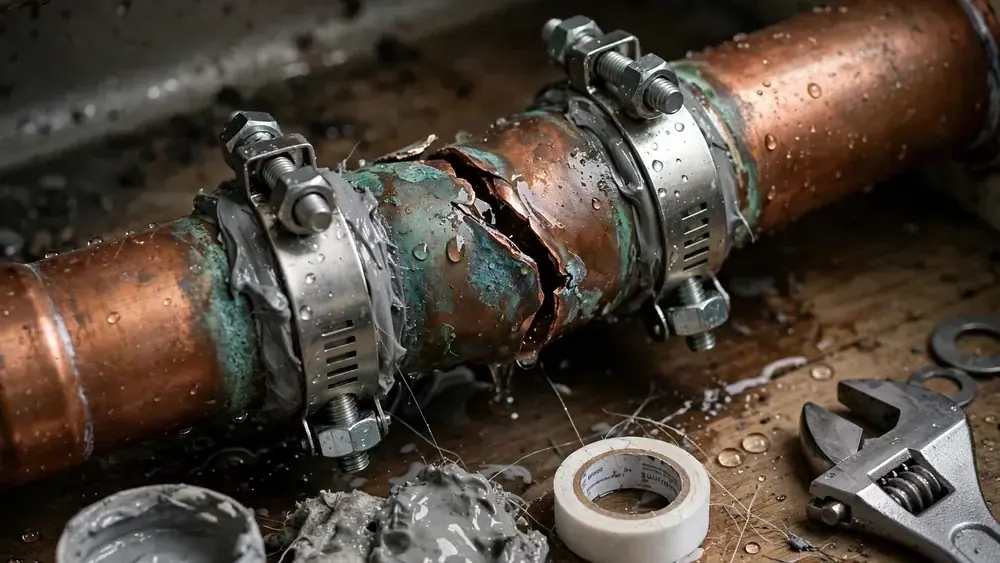
Temporary clamp or proper repair
A repair clamp can buy time, but it is not the same as replacing the damaged piece.
Temporary clamp or wrap
- Slows or stops a small leak long enough to get through a night
- Works best on a straight, clean section of pipe
- Fails on split fittings, corroded steel and pipe that keeps moving
- Leaves a weak spot hidden behind the wrap
Proper repair
- Cuts out the damaged section and installs new pipe with proper fittings
- Includes checking the rest of the line near the break for further damage
- Restores the pipe to normal pressure and temperature use
- Lets you close up the wall or ceiling with confidence in what is behind it
If the water is coming from the street side
A wet yard, water bubbling up near the meter or a break outside the foundation may be on the line between the meter and the house. That is a different job, so see water service line repair for how it is handled. If the break is on the utility's side of the meter, call your water utility's emergency line, since the dividing point differs from place to place.
After the pipe is fixed: drying out and finding the damage path
Water travels. It runs down studs, soaks insulation, and settles under floors well away from the break. We trace the damage path with a moisture meter so you know which walls and floors need to dry, and which are fine.
Drywall and insulation that stayed wet for more than a day or two often need to come out. Carpet padding is rarely worth saving after a soak. Drying and rebuilding belong to restoration contractors and carpenters, not us, but we make sure the plumbing is sound before anything is closed up. If the cause was a slow seep and not a sudden split, leak detection finds the source.
Cold snaps and frozen pipes in Etna Township
The published cold normals for central Ohio come from the Columbus airport, and they show how often a pipe here is put under stress.
Nights that matter
January's average low is about 22 F, and a typical year brings about 34 days at or below 20 F and about 103 days at or below 32 F. Each of those nights is a chance for a pipe in an exterior wall, garage or crawlspace to freeze, so keep a faucet dripping on the coldest wall from December on.
Extreme cold on record
NOAA logged wind chills of 20 to 40 below zero on 30 January 2019 and below -25 F on 22 December 2022. Wind chill does not freeze water inside a heated wall, but it pushes cold air through gaps into attics, rim joists and crawlspaces, which is where pipes split.
Mixed house ages
Most township homes were built from 1990 to 2009, with a smaller group from the 1970s and a few farmhouses older than that near the village. A 1970s house may still carry galvanized or early copper lines, so when one pipe splits there, look at the lines beside it before closing the wall.
Permits and registration
The Licking County Health Department runs the plumbing program. Plumbers must be registered, and a permit is required to repair plumbing apart from swapping a fixture for a similar one in the same spot. Ask us whether your repair needs one. Splits across the border in Reynoldsburg, Pataskala or Kirkersville follow the same steps.
Pipe split in the middle of the night?
The line rings through overnight. Close the main, then tell us what you can see.
Frequently asked questions
Water coming through a ceiling at 3 a.m. gets the same answer as a noon call. A person picks up, asks where the water is coming from, and coaches you through closing the main and opening the lowest tap while a plumber is scheduled. Same-day appointments are offered when the schedule allows, and active flooding is handled first.
Check the basement or utility room wall nearest the street, the water heater area, and a closet near the front of the house. It may be a round wheel handle or a lever. If you are not sure, tracing the pipe back from the water heater usually finds it. Test it once a year so you know it turns.
That depends on your policy, and we cannot say what yours covers. Sudden pipe failure is treated differently from long-term seepage by many insurers, so the timing and photos matter. Call your insurer and ask what they need. We can give you a plain description of what failed and why.
Usually, yes. If the split is in one section, we cut it out and install a new piece. If the pipe is badly corroded or there are splits in several places, we will discuss replacing a longer run. We check the rest of the line before closing up.
Often yes, when the repair is accessible and the area is dry enough to work. A pipe inside a finished wall may need an opening cut first, and a repair that needs a permit or inspection can add steps. We will tell you what applies before we start.
Disconnect and drain outdoor hoses, shut off and drain exterior spigots if your house has indoor shutoffs for them, and open the cabinets under sinks on exterior walls. Insulate pipes in the garage or crawlspace. If you plan to be away, leave the heat on and ask someone to check the house.