
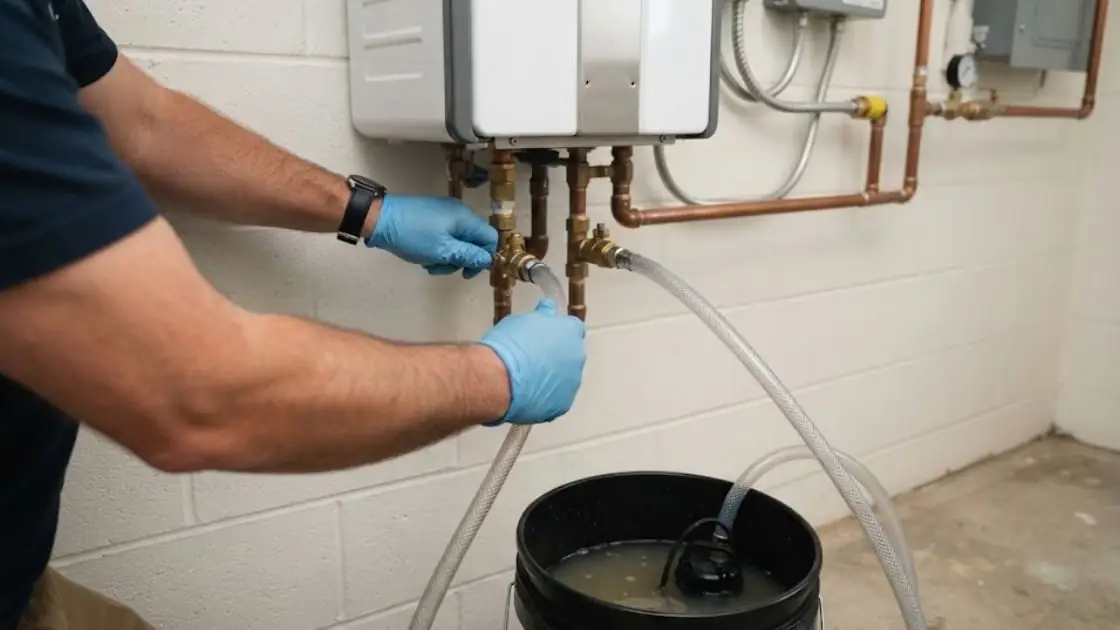
Yes, in general you do need to flush a tankless water heater. A flush means circulating a descaling solution, usually white vinegar or a descaler made for the purpose, through the heat exchanger to dissolve the mineral scale that heated water leaves behind. Skipping it will not wreck the unit overnight, but scale thickens slowly and the heater has to work harder to do the same job.
This guide covers why scale forms, what the warning signs look like, how a flush works at a high level, and how often to do one in Etna, OH. It also covers what a flush cannot fix and when a plumber should take over. Your unit's manual always outranks a general article, so read it before you touch a valve.
Why scale forms inside a tankless heater
Water carries dissolved calcium and magnesium. When a tankless unit heats that water in seconds, some of those minerals leave the solution and cling to the hottest metal surface, which is the heat exchanger. The coating starts as a film and grows with every hot-water draw.
Scale acts like insulation. An exchanger wrapped in a mineral crust needs more fuel or more electricity to reach the set temperature, and the narrow water passages inside it start to restrict flow. A scaled unit can deliver lukewarm water, a weak stream or a safety shutdown even though no part has failed.
A tank heater hides the same problem because sediment drops to the bottom of the tank. A tankless heater has no storage, so the minerals stay in the channels where the water is heated. Tight passages and fast heating are exactly what make this style of heater sensitive to scale.
Signs your tankless heater is asking for a flush
None of these proves scale by itself, but a cluster of them points that way. Rule out the simple things first: gas supply open, power on, setpoint where you left it.
Lukewarm or swinging temperature
Water that never reaches the setpoint, or that surges hot and cold during a shower, can mean the exchanger is no longer passing heat well.
Weak flow at hot taps only
If cold water is strong at a faucet and hot is weak, scale or a clogged inlet screen may be restricting the unit. Test a second faucet to rule out a fixture problem.
Error codes on the display
Most units show a numeric code when they sense overheating, poor flow or poor heat transfer. Codes differ by maker, so look yours up in the manual. The same code can have more than one cause.
Rumbling or popping sounds
Kettle-like noises as the water heats can mean scale is trapping small pockets of water against hot metal.
What to gather before you start
A flush goes smoothly when everything is within reach before the first valve moves.
- The manufacturer's manual, open to the maintenance page
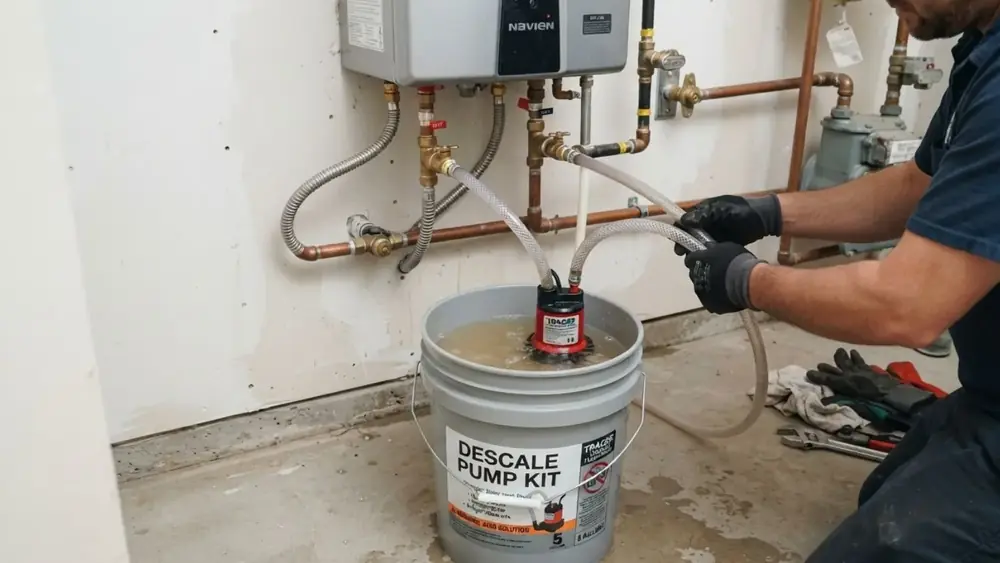
- A small submersible pump and two washing-machine style hoses with fittings that suit your service ports
- A five-gallon bucket for the solution and a second container for rinse water
- White vinegar or the descaler the manufacturer recommends
- Gloves and eye protection, because hot water and acid both cause injuries
- A hardness test kit so you can write down what your tap actually delivers
How a descaling flush works, step by step
This is the outline, not a replacement for the manual. Water inside the unit can scald, so let it cool before anything else.
- 1
Shut the unit down
Switch off the power, close the gas valve if the unit burns gas, and wait for the exchanger to cool. A gas-fired heater should never be worked on with the flame lit.
- 2
Close the isolation valves
Service valves on the hot and cold lines let you seal the unit off from the house. Without them the flush is impractical, and a plumber can add a pair so every later flush takes minutes of setup.
- 3
Connect the hoses
One hose runs from the pump to the cold-side service port. The other runs from the hot-side port back into the bucket, forming a closed loop. Open the service port caps so the solution can move through.
- 4
Circulate the solution
Pour in enough undiluted vinegar to cover the pump, or the descaler dose the maker lists, and run the loop for the time in your manual. Open a window, because vinegar fumes are sharp. Never mix vinegar with bleach or another cleaner.
- 5
Rinse and clean the screen
Drain the solution, flush the unit with clean water, then pull the inlet filter screen and rinse out any grit or flakes. Scale on that screen tells you how aggressive your water is.
- 6
Return to service
Close the service ports, open the isolation valves slowly, run a hot tap to purge air, then restore gas and power. Look at every connection for drips before you walk away.
Would you rather hand off the flush?
Tell us the make and the symptoms and we will talk through whether it is a flush, a screen cleaning or a repair. A person answers around the clock.
How often: test your tap first
There is no single schedule that fits every house. Many manufacturers suggest about once a year, homes with heavier scale benefit from more frequent flushes, and homes with very little dissolved mineral can stretch the interval. The deciding factor is your water, not the calendar.
Collect a sample from an indoor tap, run a hardness kit or send a sample to a lab, and ask your water supplier what it publishes. Annual is a sensible default if the result is moderate or high. Sooner is better if you see symptoms.
Write down the date and any error code at each flush. After two visits you will see what came out: cloudy liquid, white flakes or gritty sediment. That record lets you tighten or relax the schedule with evidence instead of guessing.
What a flush does not fix
A flush removes scale and clears the inlet screen. It does not repair a failed igniter, flame sensor, fan, flow sensor or temperature sensor, and it cannot patch a cracked heat exchanger. If a code returns right after a thorough flush, the cause is something else.
It also cannot undo years of neglect in one visit. A heavily scaled exchanger may need repeat circulation or the maker's own descaling procedure, and in the worst case the passages are blocked beyond recovery. A flush is maintenance, not prevention.
Prevention means dealing with the minerals before they reach the heater. If testing shows a lot of dissolved mineral, a water softener or filtration system is the long-term fix, and a flush then becomes a lighter chore.
Homeowner flush or plumber visit?
Plenty of owners handle a flush safely. The line is drawn by the valves you have, the fuel the unit burns and how it is behaving.
Reasonable to try yourself
- The unit already has isolation valves and service ports
- It runs normally and you are doing routine upkeep
- You have the manual and the right pump and hoses
- You can keep the space ventilated and avoid scalds
Better with a plumber
- There are no isolation valves, or they leak or will not turn
- An error code remains after a flush or returns quickly
- You smell gas, see soot or hear a carbon monoxide alarm
- The unit leaks, or the vent pipe looks loose or damaged
A code that will not clear?
Describe what the display says and what the water is doing. We can tell you if it sounds like scale or a failed part.
When to call a plumber
Gas smell, a carbon monoxide alarm, scorch marks or a flooded floor all mean the same thing: stop, ventilate and call the gas utility or 911 first. A flush is the wrong response to any of them. Once the area is safe, a person can take the call about the repair.
For everything short of that, our tankless water heater service covers flushing, isolation valve installs, diagnosis and repair, and a water heater repair visit can sort out a unit that still misbehaves after a descale. We work in Etna and the neighboring towns, including Pataskala and Reynoldsburg.
Frequently asked questions
There is no fixed number. Units can keep running for years without one, but efficiency and lifespan suffer as scale builds, and some warranties expect documented maintenance. Check the manual for the interval, then adjust it with a hardness test of your own tap water. Symptoms such as lukewarm water or a recurring code are your cue to flush sooner.
Plain white vinegar is a mild acid commonly used to dissolve scale, and many manufacturers allow it. Some name their own descaler or limit the contact time, so follow the manual. Never combine vinegar with bleach or other cleaners, rinse the unit thoroughly afterward, and keep the room ventilated while the pump runs.
Not in any practical way. Without service valves you cannot seal the unit off, so the solution would have to travel through the house plumbing. A plumber can install a valve kit on the hot, cold and, where fitted, gas lines. It is a one-time job that makes every later flush straightforward.
Usually the opposite. Many warranties expect periodic maintenance and may ask for proof of it. Read your own warranty to see what it requires, keep dates and notes of each flush, and use the solution the manufacturer approves. If the paperwork is unclear, the manufacturer's support line can confirm.
No code means scale in every brand. Codes tied to overheating, low flow or poor heat transfer often show up when the exchanger is coated, but the same codes can also come from a failed sensor or a blocked vent. Look the code up in your manual, flush if it fits, and call if the code returns.
Plan on it, then let your own results set the pace. The district publishes no hardness number, so a quick test at an indoor tap is the only way to know what reaches your heater. If your first flush brings out little scale, you can lengthen the gap. A private well calls for its own water test before any schedule.