
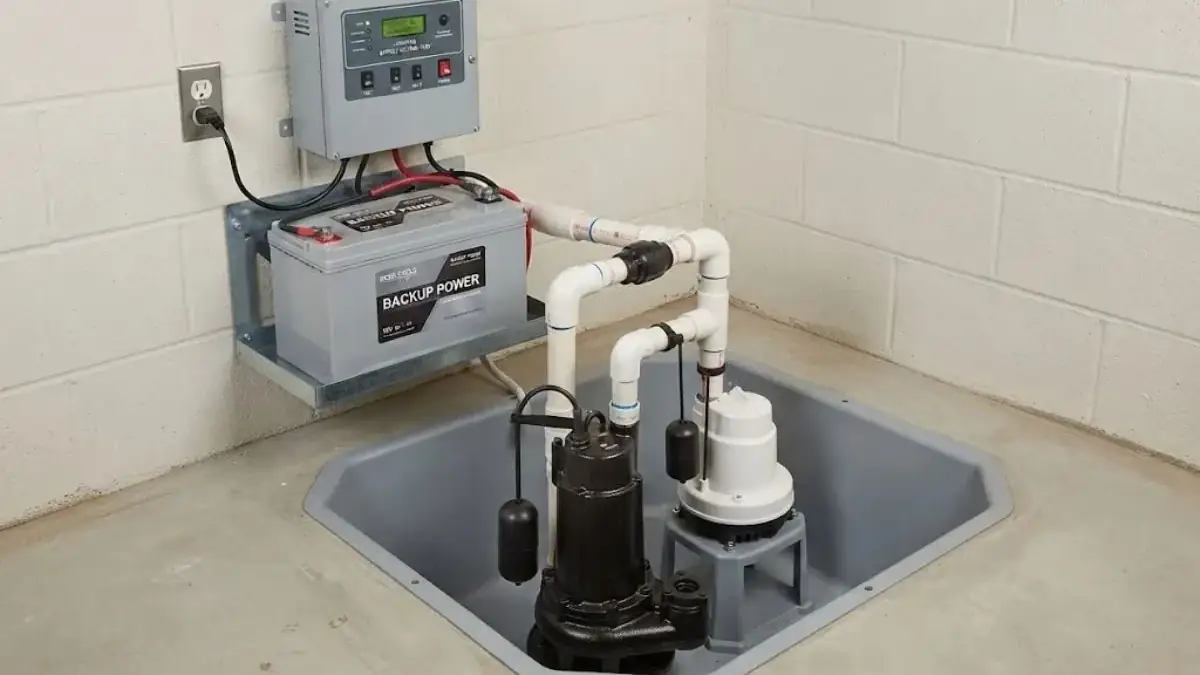
What a backup sump pump is and why it earns its place
A backup sump pump is a second pump that takes over when your primary sump pump fails or the power goes out, powered by a battery or by water pressure instead of the household circuit. It sits in the same pit or in a second one, with its own float, its own check valve, and a discharge line that joins the primary's.
Primary pumps fail in predictable ways: a float jammed against the pit wall, a motor worn out after years of cycling, an intake clogged with silt, or a dead grid. Those failures cluster in the wettest weather, which is exactly when the pit is working hardest. The backup does nothing most months and everything on the day it counts.
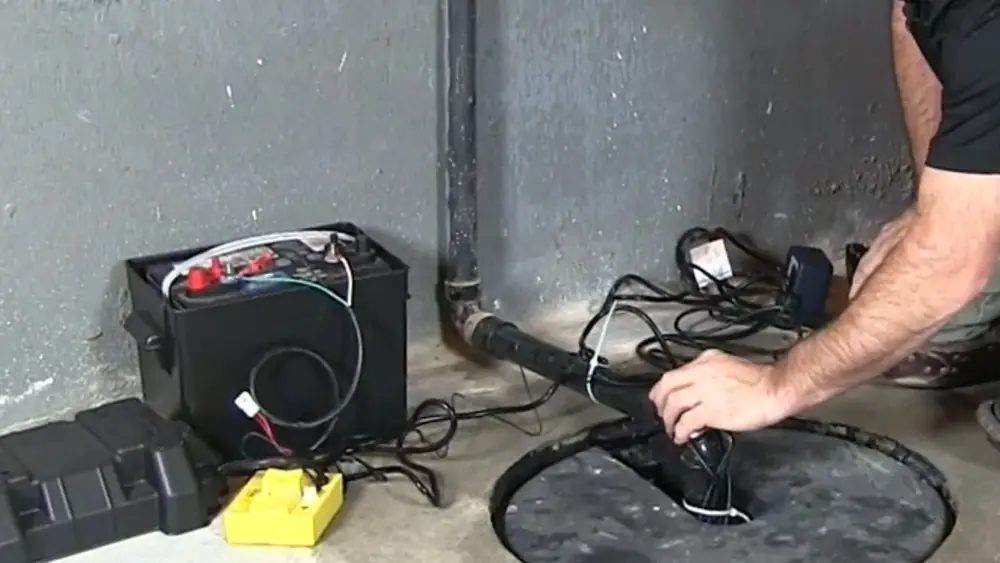
Battery, water-powered, or a second household pump
The right backup depends on how your basement is most likely to fail, a dead pump or a dead grid.
| Option | Runs on | Works in an outage | Main limit |
|---|---|---|---|
| Battery backup pump | Deep-cycle battery with a charger | Yes, until the battery runs down | Runtime depends on how fast water enters, and batteries age |
| Water-powered backup | Pressurized water from the supply line | Yes, while water pressure holds | Needs a pressurized public supply, uses more water than it moves, and backflow rules can apply |
| Second household-current pump | Household power | No, unless a generator runs it | Covers a failed pump, not a failed grid |
| Primary on a generator | Portable or standby generator | Yes, if the generator runs | Needs fuel, a safe hookup, and someone home to start it |
A water-powered unit is not an option if your home runs on a private well, because the well pump itself needs electricity.
Install sequence for a backup in the existing pit
This assumes a pit that already has a working primary pump and a discharge line that leaves the house.
- 1
Test what you have
Pour water into the pit until the float rises and watch the primary cycle on and off. Check that the check valve above the pump does not clatter or leak back, and note the pit's diameter and depth. A failing primary is better replaced than backed up.
- 2
Pick the layout
Decide between a second pit and the existing one, using the guidance in the next section. The backup's float must sit higher than the primary's, so the primary does the daily work and the backup wakes only if water keeps rising.
- 3
Unplug everything
Unplug the primary and make sure no cord is in the water. Never work in a pit with a pump connected to power.
- 4
Set the backup and plumb its check valve
Stand the backup on a level base so its float swings free of the pit wall and the primary. Run a vertical pipe up from the pump and install its own check valve, with the arrow pointing up and away from the pit. Use threaded or union fittings so the pump can be pulled for service.
- 5
Join the discharge
Bring the backup's pipe into the primary's discharge line above both check valves, using a tee or wye in the right orientation. Use the same pipe size as the primary line, and prime and cement PVC joints with the pipe dry. Give the cement time to cure before any water goes through.
- 6
Power and alarm
Connect the charger to a dedicated grounded, GFCI-protected outlet and wire the controller where it can be seen. Mount a high-water alarm so someone hears when the pit rises past the backup float.
- 7
Test, then test the outage case
Pour in water and watch each pump's float do its job. Then unplug the primary and confirm the backup runs, empties the pit, and shuts off.
Same pit or second pit
A second pit gives each pump its own float, its own intake, and its own failure mode, which is the cleanest arrangement. It also means cutting a new hole in the slab, which is a bigger, dustier job that adds a place for water to enter the floor if the sealing is poor.
Putting both pumps in one pit works when the pit is wide and deep enough that two floats can move without tangling. A pit with only room for one pump gets crowded fast, and a crowded pit is where floats hang up and the whole system stops. If the pit is narrow, sump pump service can tell you whether it is worth enlarging or replacing.
Check valves, discharge line, and what goes outside
Every pump in the system needs its own check valve, because without one the water above the pump runs back down and the pump short-cycles. Do not share one valve between two pumps. The valves should be accessible, and a clear section of pipe or a rubber coupling lets you replace one without cutting pipe.
A small relief hole drilled in the vertical pipe below the check valve prevents an air lock where the pump spins without moving water. Expect a thin spray from that hole when the pump runs. The discharge outlet should end well away from the foundation, on ground that slopes away, so the water does not circle straight back to the pit.
Winter is a common cause of failed discharge lines. The outlet can freeze or fill with debris, which stops the line and makes both pumps run against a dead end. Check the outlet before cold weather and after heavy snow, and do not tie a sump discharge into the sanitary drain. Ask your township or sewer provider about what is allowed instead of guessing.
Power outage reality
A battery backup does not run forever. How long it lasts depends on the battery's condition, the pump's draw, and how fast water enters the pit, and a long storm that keeps the pit filling can drain a battery long before the grid comes back.
A dead battery is a dead backup. Keep the charger plugged in and the terminals clean, replace the battery on the maker's schedule, and treat a long outage in a wet week as a reason to bail water or run a generator, not a reason to relax.
Pit filling and the pump is silent?
Call right away. A person answers around the clock, and while you wait, keep stored items off the floor and stay out of standing water near outlets and the panel.
Signs your primary pump may fail in the next storm
These do not mean failure is certain, but they do mean a backup is overdue.
Short cycling
The pump switches on and off every few seconds, which can mean a failing float, a bad check valve, or an undersized pit.
Loud or rough running
Grinding, rattling, or a motor that groans can mean worn bearings or debris in the impeller.
Runs without moving water
A spinning pump that pushes little or nothing may have an air lock, a clogged intake, or a failed impeller.
Pit never fully empties
If the water sits at the same level after the pump stops, the float or check valve is the first place to look.
It has never been tested
A pump that sits dry most of the year can seize, so a pump nobody has run since last spring deserves a test now.
Alarms and the testing routine
A backup nobody tests is a guess. This routine takes a few minutes each time.
- Pour a bucket of water into the pit until the primary's float lifts, and watch it empty and shut off
- Unplug the primary and repeat to prove the backup works on its own, then plug the primary back in
- Press the alarm's test button and replace its battery on a regular schedule
- Look at the battery terminals and charger light, and confirm the charger is connected
- Clear silt and debris from the pit, and check that floats move freely
- Walk the discharge line outside to the outlet and clear leaves, ice, and snow
Want a plumber to set the backup?
We install and service pumps around Etna, Pataskala, and Reynoldsburg. Call, tell us what is in the pit now, and we will find the next appointment when one is available. For wet walls and seepage beyond the pit, see basement waterproofing.
Frequently asked questions
It suits homes on pressurized public water that face long outages, because it needs no battery. It does use water while it runs, often more than it removes, and backflow rules can apply, so ask your water provider before you buy.
It will not work on a home whose own well pump needs electricity, because the pressure it relies on disappears with the power.
There is no single number. Runtime depends on the battery's size and age, how hard the pump works, and how quickly water enters the pit.
A backup that is fully charged and well maintained can carry a short storm. A long outage during a wet spell can drain it, which is why a generator or a plan for bailing is part of the real answer.
If the work goes into the ground, yes. Ohio law, in a section effective 9 June 2026, requires excavators to notify the protection service at least two working days, not counting the day of notice, and not more than sixteen calendar days, before digging.
Calling is how buried utility lines are marked, and it is the step that keeps a shovel away from them.
Yes. Each pump needs a check valve so water above it cannot run back down. Without one the pump short-cycles, and the primary's valve cannot protect the backup.
Join the two discharge pipes above both valves with a tee or wye so they share one outlet, but never let them share a single valve.
Often, if the pit is wide and deep enough for two pumps and the floats move freely. A cramped pit makes floats snag and the system stops.
If the pit is narrow, a second pit or a pit replacement is the better route, and the backup's float should sit higher so the primary does the daily work.
Yes. An alarm is a separate warning that does not rely on the pumps working, so it tells you when water has passed the backup's float.
Place it where someone will hear it, test it with the pump routine, and keep its battery fresh. It is the part of the system that gets you out of bed when the pumps cannot keep up.