
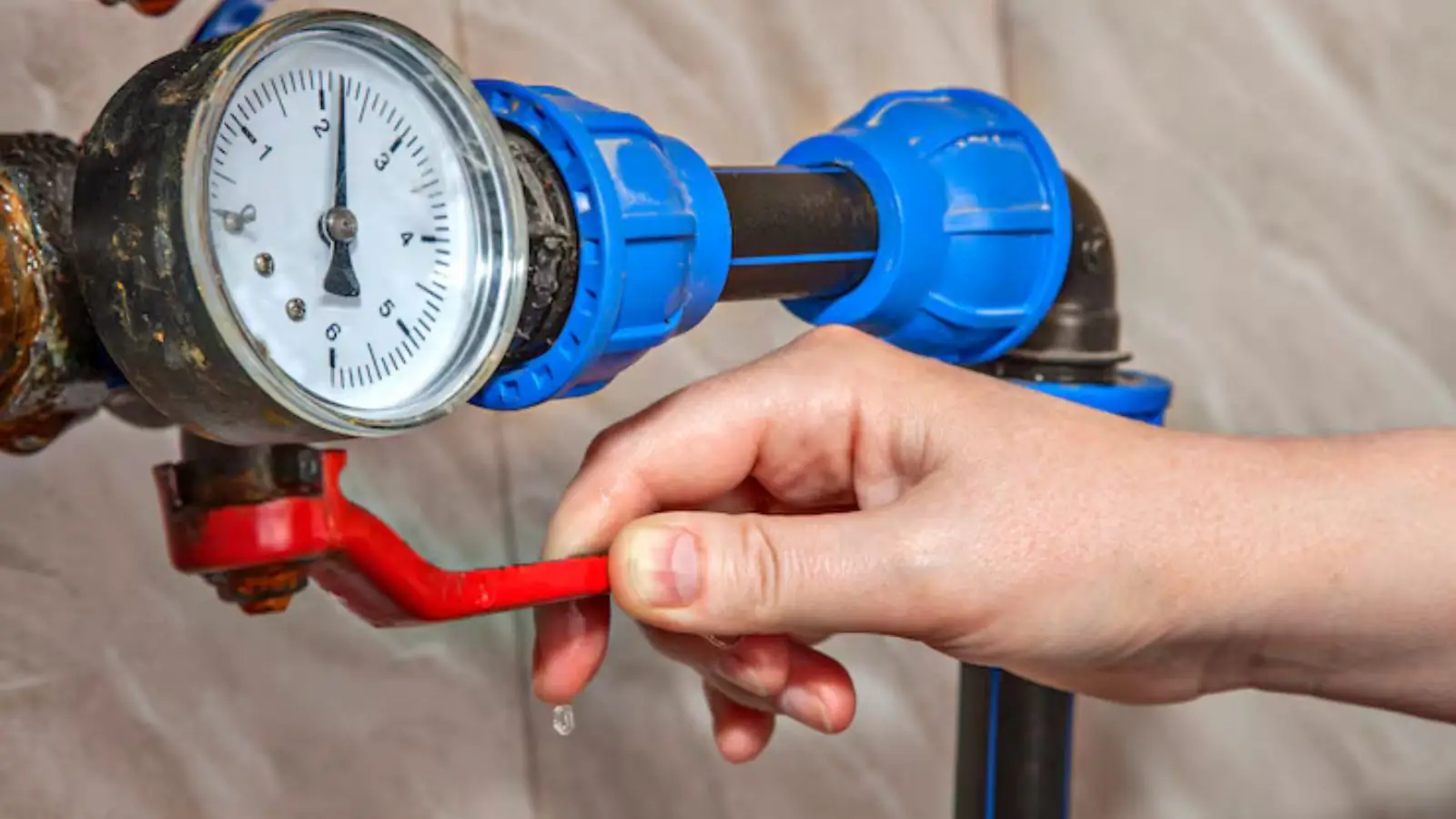
Low water pressure in a house means water leaves your taps and showers with less force than it should, either at a single fixture or across the whole home. The cause is usually a clog, a partly closed valve, a failing regulator or a leak, and which one it is depends on where the weak flow shows up. A twenty-minute test with a cheap gauge turns the guess into a number.
This article sorts the causes by where you notice them, gives you the safe checks to run yourself, and explains the pressure range a house normally sees. It also covers the opposite problem, because high pressure can wear out a plumbing system faster than a weak shower ever will.
One fixture or the whole house: a quick decision table
Start with the pattern. It tells you how much of the plumbing you need to suspect.
| What you notice | Most likely cause | First thing to try |
|---|---|---|
| Only one faucet or showerhead is weak | Clogged aerator or showerhead screen, or a partly closed stop | Unscrew and clean the aerator, then open the fixture's shutoff fully |
| Hot is weak, cold is fine | Water heater valve, sediment or a clogged hot-side line | Check the heater's shutoff valve and compare hot and cold at one tap |
| Every fixture is weak, all day | Main valve partly closed, failing regulator or a service line leak | Check the main valve, then run a gauge test |
| Pressure is fine at night, weak in the morning | Supply side demand, or a regulator that is struggling | Compare gauge readings at different hours |
| Weak with rust-colored water | Galvanized pipe buildup | Ask for a pipe inspection, since scale does not clean out |
Hot-only and cold-only patterns narrow the search faster than any gauge.
Easy fixes you can try first
Work through these in order before assuming something big is wrong. None of them require tools beyond pliers and a rag.
- Unscrew each faucet aerator, rinse out the mineral grit and debris, then reinstall it hand-tight.
- Soak a showerhead in white vinegar in a bag for an hour, then scrub the nozzles with a small brush.
- Open the stop valve under the sink all the way, since a quarter-closed valve is a common leftover from an old repair.
- Make sure the main shutoff valve is fully open, with the handle in line with the pipe.
- Check that a water heater shutoff or a filter cartridge has not clogged, which shows up as weak hot water or weak flow everywhere.
How to test pressure at a hose bib
A pressure gauge screws onto an outdoor spigot like a hose and is sold at most hardware stores. It shows the pressure your home actually receives.
- 1
Turn everything else off
Close all taps and appliances, so no water is moving. A running toilet or irrigation zone will give a false low reading.
- 2
Attach the gauge
Thread the gauge onto the hose bib hand-tight, with the rubber washer in place so it does not drip.
- 3
Open the spigot and read
Open the bib fully and note the needle. Many households see roughly 40 to 80 psi, which is a general industry range and not a code requirement.
- 4
Test again at a different time
Read it again late at night and during peak morning use. A big swing points to supply or regulator trouble.
- 5
Compare to a low reading elsewhere
If the gauge reads well but a fixture is weak, the problem sits at that fixture. If the gauge itself is low, work through the whole-house causes below.
Whole-house causes, from simplest to hardest
When every fixture is weak, the problem sits upstream of the branches. These are the usual suspects.
A partly closed main valve
After plumbing or meter work, a main valve can end up partly shut. Turn it fully open and see if the symptoms disappear.
A failing pressure regulator
A regulator, sometimes called a PRV, is a bell-shaped valve near where the main enters the house. When it fails, pressure can drop or spike. Replacing one is a plumber's job because it involves the main line.
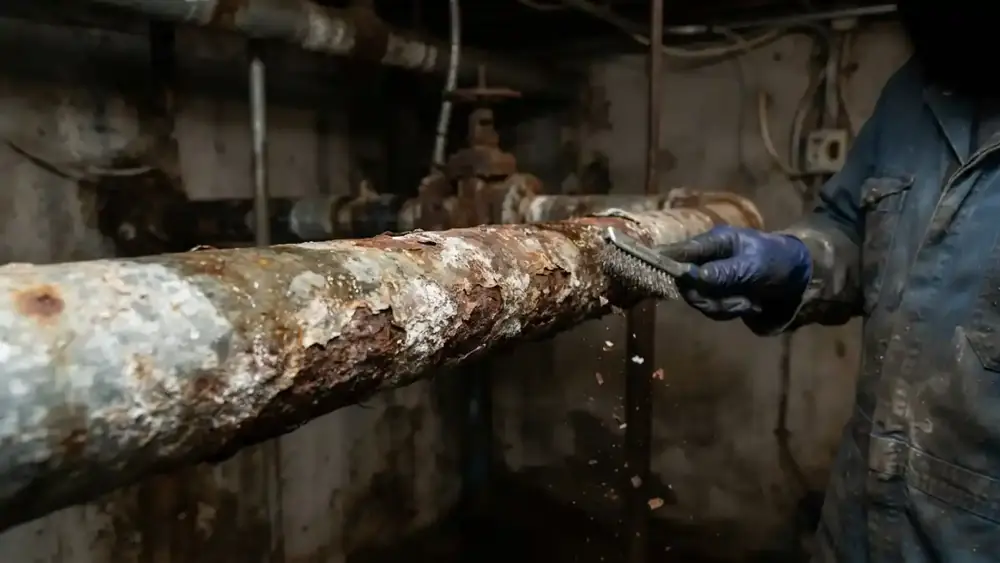
Galvanized pipe buildup
Older steel pipe corrodes inside, so the opening narrows over years while the outside looks fine. The fix is replacement, and our repiping page covers what that involves.
A leak in the service line
A leak between the meter and the house sends water into the soil before it reaches your taps. A wet patch, a spinning meter with fixtures off and low pressure together point to it. See water service line repair for what the repair looks like.
Too many fixtures on a small line
Undersized pipe or a long run can starve a bathroom far from the main, especially when other water use overlaps.
Pressure tank symptoms on a well
A well system stores water in a pressure tank and uses a pressure switch to start the pump. If the pump cycles on and off quickly, the tank has lost its air charge or has failed. If the gauge shows low pressure that never builds, the pump, a clogged filter or a tripped breaker is the likely cause. Do not open the electrical box, and shut off power at the breaker before checking any wiring.
Still weak after the easy fixes?
Tell us which fixtures are weak, what the gauge says and if you are on public water or a well, and we will help you choose the next step.
When pressure is too high
High pressure feels great in the shower and quietly damages the system. Pressure above roughly 80 psi stresses supply lines, washing machine hoses, toilet fill valves and water heater connections, and it is a common cause of pinhole leaks and dripping fixtures. A gauge reading near that level, a banging sound when a valve closes or a relief valve that weeps are signs to have the regulator checked soon.
Thermal expansion is a related trap. When a water heater warms the water, the volume grows, and on a closed system with a check valve at the meter, the pressure can climb with nowhere to go. An expansion tank is the usual answer, which is a topic for a plumber to size and install.
What a plumber checks first
A technician starts with a gauge at the hose bib, then checks the main valve, the regulator and the line. If the numbers do not add up, we follow the pipe, looking for narrowing in old galvanized runs, restrictions at the meter and wet spots in the yard. Sometimes the answer is a five-minute valve adjustment, and sometimes a section of pipe has to be replaced.
We serve homes around Pataskala and out toward Kirkersville, and the same diagnosis applies in both. Tell us the age of the house, the pipe material you can see at the water heater and if the house runs on a meter or a well.
Talk through a pressure problem
Phones are staffed day and night. Describe the pattern and we will say whether it sounds like a fixture, a regulator, the pipes or the supply.
Frequently asked questions
A single weak bathroom usually means a clogged aerator or showerhead, a partly closed stop valve or a narrowed branch line. If the cold side is fine and only hot is weak, look at the water heater valve. When both hot and cold are weak in one room, the problem may sit in the line serving that bathroom.
Some regulators have an adjustment screw, but getting it wrong can leave you with too much pressure and a damaged fixture. Because the regulator sits on the main line and affects everything in the house, we recommend having a plumber check the setting with a gauge before and after any change.
Galvanized steel rusts from the inside, and the buildup shrinks the opening over decades. You may see weak flow, brown water and pressure that drops when two fixtures run at once. Cleaning rarely lasts, so the realistic fix is replacing the affected runs with copper or PEX.
It can be. A leak in the service line, between the meter and the house, loses water before it reaches your taps. Look for a wet spot in the yard, a meter that moves with all fixtures off and a pressure drop that is steady across the house.
Check the main valve and read a hose bib gauge, then call the Licking Regional Water District to ask whether anything is happening on the street. If the district's side is normal, call us, and we will test the house side and the service line. Having your gauge reading ready makes both calls shorter.
Cleaning a filter and checking that breakers are on is safe. The pump, pressure switch and tank charge involve electricity and stored pressure, so turn off the breaker and call someone. Private water systems in Licking County are regulated by the health department, so alterations can need a permit.